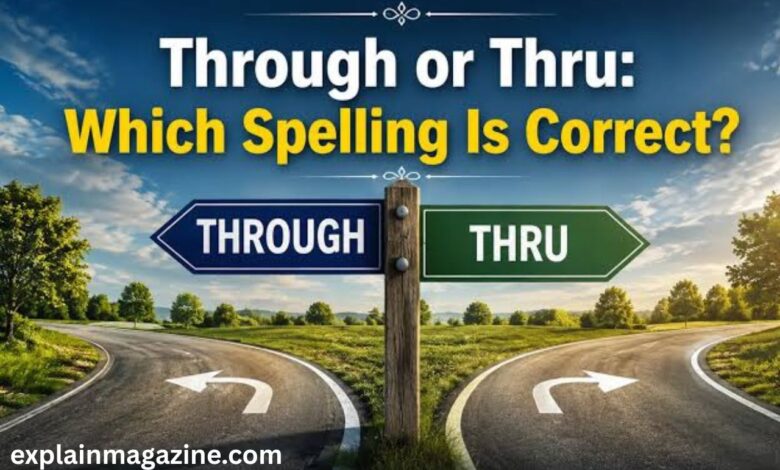
through or thru English contains many words that create confusion because of alternative spellings, abbreviations, and informal usage. One common example is the debate between through and thru. Since both words are pronounced the same way and often appear in everyday communication, many writers wonder which spelling is correct and when each should be used.
You may have seen “through” in books, business emails, and school assignments, while “thru” often appears on road signs, restaurant advertisements, and drive-thru lanes. Although the two forms share the same basic meaning, they are not always interchangeable.
In this guide, we will explore the meaning, grammar, spelling, examples, and correct usage of through and thru. We will also explain related questions such as “through or thru for dates,” “drive through or drive thru,” and the difference between through, thru, and threw.
Correct Examples
- We walked through the park.
- The office is open Monday through Friday.
- She read through the report carefully.
Informal Examples
- Use the drive-thru lane.
- The sign says No Thru Traffic.
- Text me when you get thru the line.
In most situations, choosing “through” is the safest option.
Through or Thru Meaning
The words through and thru generally have the same meaning.
They can describe:
- Movement from one side to another
- Completion of a process
- Passage through an area
- Continuation over a period of time
- Experiencing a situation
Examples:
- We drove through the tunnel.
- She worked through the problem.
- The sale runs through Friday.
- They went through difficult times.
The difference is not meaning but formality and spelling style.
Through or Thru: Which Is Correct?
If the question is simply “Which is correct?” the answer is through.
While dictionaries may recognize “thru” as an informal variant, it is not considered the preferred spelling in formal English.
| Word | Status |
|---|---|
| Through | Standard English |
| Thru | Informal Variant |
For professional writing, always choose through.
When to Use Through or Thru
Use Through When:
- Writing school assignments
- Writing business emails
- Publishing articles
- Creating professional documents
- Writing formal letters
- Describing date ranges
Examples:
- The conference runs through Saturday.
- Please read through the instructions.
- We worked through the issue together.
Use Thru When:
- Writing casual text messages
- Creating signs
- Using branding language
- Referring to drive-thru services
- Saving space on advertisements
Examples:
- Drive-thru open 24 hours.
- No thru road.
- Walk-thru available.
The key difference is the level of formality.
Drive Through or Thru
One of the most common places where people encounter the shorter spelling is in restaurants.
Both forms can be seen:
- Drive-through
- Drive-thru
However, drive-thru has become extremely common in commercial branding and signage because it is shorter and easier to display. In formal writing, many style guides still prefer drive-through, while businesses often use drive-thru as part of their brand identity.
Walk Through or Thru
The standard phrase is:
Walk through
Examples:
- Let me walk through the process.
- We took a walk through the museum.
- The manager walked through the presentation.
Although “walk-thru” may appear in software guides or marketing materials, “walk through” remains the preferred standard form.
Going Through or Thru
The correct standard expression is:
Going through
Examples:
- I am going through my emails.
- She is going through a difficult time.
- We are going through the contract.
The form “going thru” is generally limited to casual texting and informal messages.
Come Through or Thru
The accepted expression is:
Come through
Examples:
- Your payment came through.
- She always comes through when needed.
- The message came through clearly.
In formal writing, avoid “come thru.”
Through or Thru for Dates
A frequently searched question concerns date ranges.
The standard form is:
- Monday through Friday
- July 1 through July 10
- Open through December
This usage means the ending date is included.
While advertisements may occasionally use “thru,” professional writing should use through when referring to dates and time periods.
Dates Through or Thru
Examples of correct usage:
- Registration is open through August 15.
- The event runs Monday through Friday.
- Membership is valid through the end of the year.
These examples follow standard English conventions.
Paid Through or Thru
Financial and business documents almost always use:
Paid through
Examples:
- Rent is paid through June.
- Your subscription is paid through December.
- Fees are paid through the current billing cycle.
The form “paid thru” may appear informally but is generally avoided in professional communication.
Through or Thru in a Sentence
Here are several examples showing proper usage.
Through
- She walked through the forest.
- The train passed through the tunnel.
- We worked through the challenge.
- He stayed calm through the crisis.
- The office is open Monday through Friday.
Thru
- The drive-thru is open all night.
- We got thru the long line quickly.
- The sign says No Thru Traffic.
These examples show how the meaning remains similar while the level of formality changes.
Through or Thru Traffic
Road signs frequently use:
Thru Traffic
Examples:
- No Thru Traffic
- Local Traffic Only
- Thru Route
Transportation departments often choose the shorter spelling because it fits better on signs and is easy for drivers to read quickly. In ordinary writing, however, “through traffic” remains the standard form.
Through, Thru, or Threw
Many learners confuse these three words.
Through
Means movement, passage, duration, or completion.
Example:
- We walked through the park.
Thru
An informal spelling of through.
Example:
- We walked thru the park.
Threw
Past tense of throw.
Example:
- He threw the ball.
A sentence can correctly use both:
- He threw the ball through the window.
This is one of the easiest ways to remember the difference.
Common Mistakes to Avoid
Mistake 1
Using “thru” in academic or professional writing.
Mistake 2
Assuming “through” and “threw” mean the same thing.
Mistake 3
Using “thru” in formal date ranges and business documents.
Mistake 4
Believing “thru” is the preferred spelling in modern English.
In reality, “through” remains the standard choice in nearly all formal contexts.
Conclusion
Read More: Truly or Truely: Which Spelling Is Correct?
The answer to the question through or thru depends largely on context. Through is the standard and preferred spelling used in formal, academic, professional, and everyday writing. Thru is an accepted informal variant commonly found on signs, advertisements, road markings, and phrases such as drive-thru.
A simple rule to remember is:
Use through for writing. Use thru for signs and casual shorthand.
Whether you are discussing dates, payments, traffic signs, emails, or everyday communication, choosing the correct spelling will make your writing clearer and more professional. At explainmagazine, our goal is to simplify confusing English grammar and word-choice questions so readers can communicate with confidence.