Principle or Principal: Which Is Correct? Loan, Finance, Agreement, and Business Uses Explained

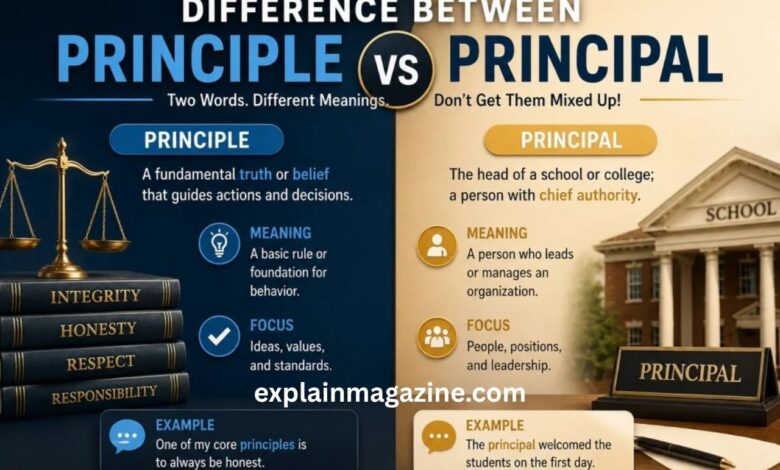
The words principle and principal are among the most frequently confused terms in the English language. They sound nearly identical, but they have different meanings and are used in very different situations. The confusion becomes especially common when people write about loans, finance, business, research, agreements, or professional positions. Questions such as “Is it principle or principal on a loan?”, “Is it agreement in principle or principal?”, and “Is it principal investigator or principle investigator?” are common because the two spellings are so similar.
The simplest distinction is that principle generally refers to a rule, belief, standard, or fundamental idea, while principal can mean the main or most important thing, a person in a leading position, or a sum of money. Merriam-Webster confirms that principal can function as both an adjective and a noun, whereas principle functions as a noun.
Quick Facts Table
| Word or Phrase | Correct Form | Meaning |
|---|---|---|
| Loan amount | Principal | Money borrowed |
| Loan balance | Principal | Money still owed |
| Principal payment | Principal | Payment reducing loan balance |
| Agreement in principle | Principle | General agreement |
| Agreed in principle | Principle | Agreement on the basic idea |
| Agree in principle | Principle | Accept an idea generally |
| Settlement in principle | Principle | General settlement agreement |
| Out of principle | Principle | Because of a belief or value |
| Principal investigator | Principal | Lead or primary investigator |
| Principal engineer | Principal | Senior or primary engineer |
| Principal place of business | Principal | Main business location |
| Company principal | Principal | Person in a leading position |
| Financial principle | Principle | Rule or concept |
| Principal in finance | Principal | Money invested or borrowed |
What Does Principle Mean?
Principle is a noun that refers to a fundamental rule, belief, standard, law, or idea. It is commonly used when discussing ethics, personal values, scientific concepts, business practices, and general rules.
For example:
- Honesty is an important principle.
- The machine operates according to a basic scientific principle.
- She refused the offer on principle.
- The organization follows several important principles.
- The investment strategy is based on sound financial principles.
Merriam-Webster defines principle as including a fundamental law or doctrine, a rule or code of conduct, and an underlying quality that influences behavior.
A useful way to remember this meaning is to connect principle with rules and beliefs.
What Does Principal Mean?
Principal has several meanings. As an adjective, it generally means main, primary, chief, or most important. As a noun, it can refer to a person with authority or a sum of money.
For example:
- The principal reason for the decision was cost.
- The school’s principal spoke to the students.
- She is the principal investigator on the project.
- The principal amount of the loan is $25,000.
- The company’s principal place of business is in London.
Merriam-Webster lists “most important” as an adjective meaning of principal and includes a leading person and a capital sum earning interest or due as a debt among its noun meanings.
Therefore, principal is the correct spelling when you mean main, primary, a person in charge, or money.
Principle or Principal: The Basic Difference
The easiest rule is:
Principle = a rule, belief, or fundamental idea.
Principal = main, primary, a person in charge, or money.
Consider these examples:
“She refuses to compromise her principles.”
Here, principles means beliefs or moral standards.
“The principal reason for the change was cost.”
Here, principal means main.
“The borrower paid $500 toward the loan principal.”
Here, principal means the amount of money owed.
This distinction explains nearly every example involving the keywords covered in this article.
Loan Principle or Principal?
When discussing a loan, the correct word is principal.
The loan principal is the amount of money borrowed, or, depending on context, the amount of that borrowing that remains unpaid. The Consumer Financial Protection Bureau explains that the principal is the amount borrowed, while interest is the lender’s charge for lending the money.
For example:
“The original principal on the loan was $30,000.”
You should not write “loan principle” when referring to borrowed money.
Correct terms include:
- Loan principal
- Principal balance
- Principal amount
- Principal payment
- Principal and interest
- Principal repayment
Is It Principle or Principal on a Loan?
The answer is principal.
If you are talking about the money you borrowed or the amount remaining to be repaid, use principal.
For example:
“I still owe $12,000 in principal on my car loan.”
The word principle would be incorrect because the sentence refers to money rather than a rule or belief.
The CFPB similarly explains that the amount borrowed on a mortgage is called the principal or mortgage balance.
Principle or Principal Payment?
The correct phrase is principal payment.
A principal payment is the portion of a loan payment that reduces the principal balance. A typical loan payment may contain both principal and interest. The CFPB explains that the portion applied to principal reduces the amount owed, while interest represents the cost of borrowing.
For example:
“Making additional principal payments can reduce the loan balance faster.”
Therefore:
Correct: Principal payment
Incorrect: Principle payment
Principle or Principal on a Loan
Again, principal is correct.
The phrase “principal on a loan” refers to the borrowed amount or remaining loan balance.
For example:
“The borrower has already repaid half of the principal on the loan.”
The distinction is especially important in financial documents because principal has a specific technical meaning related to debt and investment. The CFPB uses the term principal to describe the amount borrowed and distinguishes it from interest.
Principle or Principal in Finance?
The correct word depends on what you are describing.
Use principal when talking about money:
- Principal investment
- Principal amount
- Principal balance
- Principal repayment
- Loan principal
- Principal and interest
Use principle when talking about a rule or concept:
- Investment principle
- Financial principle
- Economic principle
- Accounting principle
- Principle of diversification
For example:
“The investor received the principal after the investment matured.”
Here, principal means money.
But:
“Diversification is an important investment principle.”
Here, principle means a fundamental concept.
In Finance, Is It Principle or Principal?
When the subject is the amount of money, use principal.
This is one of the most important distinctions to remember. Principal can refer to a capital sum that earns interest or is owed as a debt.
For example:
“The bank calculates interest based on the outstanding principal.”
On the other hand, if you are discussing a rule governing financial behavior, use principle.
For example:
“The company follows the principle of financial transparency.”
Agreement in Principle or Principal?
The correct expression is agreement in principle.
An agreement in principle means that people or organizations have reached a general understanding about an idea, proposal, or arrangement. Some final details may still need to be settled.
For example:
“The two companies reached an agreement in principle.”
The word principle is correct because the expression refers to agreement on the basic idea or fundamental terms.
“Agreement in principal” is incorrect when used in this sense.
Agreed in Principle or Principal?
The correct phrase is agreed in principle.
For example:
“The parties have agreed in principle to the proposed arrangement.”
This means they have accepted the basic proposal, even if formal paperwork or specific details remain.
The word principle refers to the fundamental idea that has been accepted.
Agree in Principle or Principal?
The correct phrase is agree in principle.
Examples include:
- “We agree in principle with the proposal.”
- “The board agreed in principle to the plan.”
- “The parties agree in principle on the main terms.”
Here, principle means the basic idea or general concept.
Settlement in Principle or Principal?
The correct expression is generally settlement in principle.
For example:
“The parties reached a settlement in principle.”
This means that the parties have reached a general settlement agreement, although formal documents or remaining conditions may still need to be completed.
The word principle is appropriate because the phrase concerns agreement on the basic terms rather than a monetary principal.
Money: Principle or Principal?
When referring to a sum of money, use principal.
For example:
“The investment returned the original principal.”
“The borrower made a large payment toward the principal.”
In financial terminology, principal can mean the original amount invested or borrowed.
However, financial principle is also correct when referring to a rule or concept.
For example:
“The principle of compound growth is important in investing.”
The key is the meaning:
Money = principal
Rule or concept = principle
Principle or Principal of a Company?
This depends on the intended meaning.
If you are referring to a person who holds a leading or controlling position in a company, principal is appropriate.
For example:
“She is a principal of the consulting firm.”
Here, principal refers to someone in a leading position. Merriam-Webster recognizes this use of principal for a person with controlling authority or a leading role.
But if you are talking about a company’s values, use principles.
For example:
“The company’s principles include honesty and transparency.”
Therefore:
Company leader = principal
Company values = principles
Principle or Principal Investigator?
The correct phrase is principal investigator.
A principal investigator is the lead or primary researcher responsible for a study, research project, or grant.
The word principal is correct because it means primary or chief.
For example:
“Dr. Ahmed is the principal investigator for the research project.”
“Principle investigator” is a common spelling error.
The phrase is also used in official research and grant terminology. For example, Pakistan’s Higher Education Commission uses “Principal Investigator” as the title for the person responsible for a funded research project.
Is It Principle or Principal Investigator?
Always use principal investigator when referring to the lead researcher.
A simple way to remember it is:
Principal investigator = primary investigator.
Because principal means main or primary, it is the correct word.
Principle or Principal Place of Business?
The correct phrase is principal place of business.
Here, principal means the main or primary location where a company conducts its business.
For example:
“The company’s principal place of business is in California.”
Merriam-Webster’s legal definition of principal specifically includes “principal place of business” as an example of principal meaning main or most important.
Therefore, “principle place of business” is incorrect.
Principle or Principal Engineer?
The correct phrase is generally principal engineer when referring to a senior or leading engineering position.
For example:
“She was promoted to principal engineer after years of technical experience.”
Here, principal means a leading or primary position.
The spelling “principle engineer” is incorrect for this professional title.
Out of Principle or Principal?
The correct expression is out of principle.
For example:
“He refused the offer out of principle.”
This means that the person refused because accepting would conflict with his beliefs or values.
Other correct expressions include:
- On principle
- As a matter of principle
- A matter of principle
- Against my principles
- Guided by principles
Merriam-Webster gives examples such as acting “as a matter of principle” and refusing something “on principle.”
How to Remember Principle and Principal
Several memory tricks can make this distinction easier.
One popular mnemonic is:
The principal is your pal.
This is useful because principal can refer to a person, such as a school principal or company principal.
Another trick is:
Principle ends like “rule.”
Both principle and rule can describe a standard or guiding idea.
You can also remember:
Principal has an A, like adjective.
Principal can function as an adjective meaning “main” or “most important.” Principle does not function as an adjective in standard usage.
Common Examples at a Glance
| Incorrect Usage | Correct Usage | Reason |
|---|---|---|
| Loan principle | Loan principal | Money borrowed |
| Principle payment | Principal payment | Payment reducing debt |
| Principle amount | Principal amount | Financial amount |
| Principle balance | Principal balance | Remaining debt |
| Agreement in principal | Agreement in principle | General agreement |
| Agreed in principal | Agreed in principle | Accepted basic terms |
| Agree in principal | Agree in principle | Accept an idea |
| Settlement in principal | Settlement in principle | General settlement |
| Principle investigator | Principal investigator | Primary researcher |
| Principle engineer | Principal engineer | Leading engineering role |
| Principle place of business | Principal place of business | Main business location |
| Out of principal | Out of principle | Based on beliefs |
| Company principle | Company principal | Person in a leading position |
Final Answer: Principle or Principal?
Read More: Marco Pigossi: Husband, Partner, Gay Identity, Gen V, Tidelands, Movies and TV Shows
The answer depends entirely on what you mean.
Use principle when referring to a rule, belief, value, standard, or fundamental idea. Examples include agreement in principle, agreed in principle, agree in principle, settlement in principle, financial principle, and out of principle.
Use principal when referring to money, something primary or most important, or a person in a leading position. Examples include loan principal, principal payment, principal balance, principal investigator, principal engineer, principal place of business, and company principal. These distinctions are consistent with dictionary definitions and established financial terminology.
The easiest rule to remember is: principle is about rules and beliefs; principal is about main things, people, and money. Once this distinction becomes familiar, phrases involving loans, finance, agreements, business, and professional titles become much easier to spell correctly. At ExplainMagazine, we hope this guide helps readers use these two commonly confused words accurately and confidently in everyday and professional writing.