









Ephraim is a Hebrew name that means “fruitful” — and it carries more history than most names. It belongs to a son in the Bible, a tribe in ancient Israel, a kingdom in the prophets’ words, a baby name today, and a small town in Utah. This article separates the meanings, so you always know which one is meant.
The short answer is simple: when people ask what Ephraim means, the answer is “fruitful” or “doubly fruitful”. The longer answer is more interesting, because even the scholars do not fully agree on where the name came from.
What Does the Name Mean?
The Short Answer
Ephraim means “fruitful” — or, in the fuller form, “doubly fruitful”. It is the English spelling of the Hebrew name Efrayim, read that way for centuries: a wish for fruitfulness, abundance, a life that produces something good even in hard times.
The Hebrew Word Behind It
The name comes from the Hebrew root para, “to be fruitful” or “to bear fruit”. Joseph himself gives the meaning: when his second son was born in Egypt, Joseph named him Ephraim and said, “God has made me fruitful in the land of my affliction” (Genesis 41:52).
Why the Meaning Is Debated
Here is the honest part: not everyone agrees on the exact etymology. Most dictionaries give “fruitful” or “doubly fruitful”, and that is the traditional reading. But Strong’s Hebrew dictionary also lists a second reading, “double ash-heap”, from a different root, ‘eper, meaning ashes. Some scholars say the name may have begun as a label for a fertile stretch of hill country, and the Bible’s explanation may be a play on its sound. No single etymology is settled.
Ephraim in the Bible: Joseph’s Son
Born in Egypt
He was the second son of Joseph and Asenath, born in Egypt while Joseph served Pharaoh (Genesis 41:50–52). His elder brother was Manasseh. Both boys were born far from their father’s home — and both of their names tell that story.
The Blessing That Crossed Hands
The most famous scene comes at the end of Genesis. When Jacob blessed Joseph’s two sons, he deliberately crossed his hands, placing his right hand — the hand of the greater blessing — on the younger Ephraim instead of on the elder Manasseh (Genesis 48:8–20). Joseph tried to correct him, but Jacob refused: the younger son, he said, would become greater.
What the Blessing Led To
That blessing was not only about one boy: the boy became the ancestor of a whole tribe, and the name became the name of a people, a territory and, later, a kingdom.
The Tribe of Ephraim
Land and Place
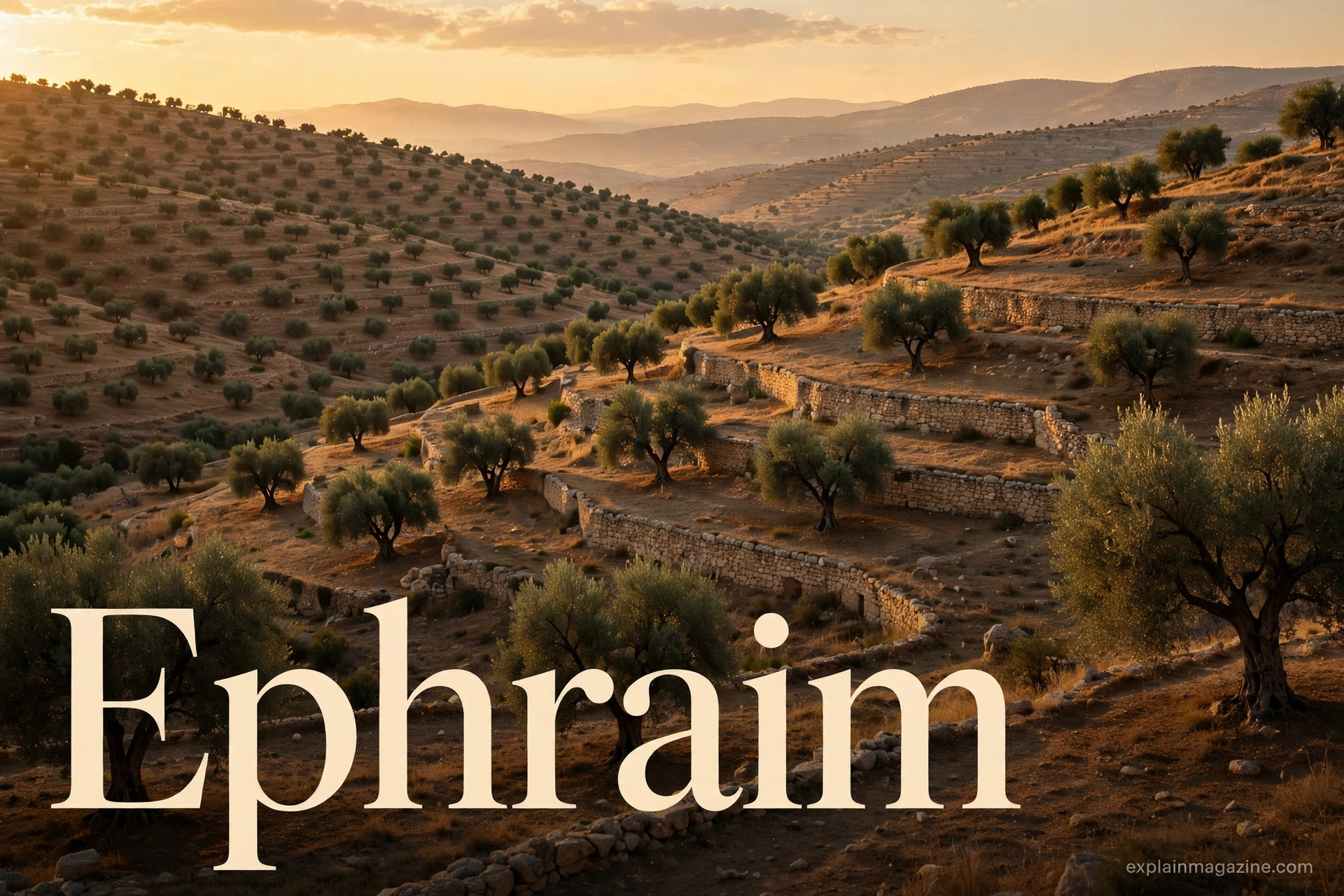
The tribe of Ephraim settled in the fertile hill country of central Canaan, between Benjamin and Manasseh. Its land included Shiloh, where the tabernacle stood, and Shechem, a major town in early Israel.
A Powerful Tribe
Among the tribes of Israel, it was one of the most prominent: numerous, holding important religious sites, its leaders playing a large role in early Israel.
The Two Brothers Compared
The two brothers’ tribes are often mentioned together, so it helps to compare them directly.
| Younger brother | Elder brother | |
|---|---|---|
| Birth order | Second son | First son |
| Blessing | Greater blessing (crossed hands) | Lesser blessing |
| Territory | Hill country of central Canaan | Both sides of the Jordan |
| Key towns | Shiloh, Shechem | Samaria (later) |
| Later role | Leading tribe; name of the northern kingdom | Large tribe, in two halves |
Ephraim as the Northern Kingdom
Why the Prophets Used the Name
After the kingdom of Israel split in two, the prophets — Isaiah, Jeremiah and Hosea — often called the northern kingdom by this name, because the tribe was the leading tribe of the north, so its name stood for the whole kingdom.
What Happened to It
The northern kingdom fell to Assyria and its people were scattered, but the name lived on as a prophetic shorthand long after the kingdom was gone.
Other Places Called Ephraim
The Hill Country
The hill country was the central highlands where the tribe lived. In the Bible it works as an address: people are described as coming from the hill country.
The Town in John 11:54
There was also a town of that name: in John 11:54, Jesus withdrew to it, near the wilderness, before his final Passover in Jerusalem.
The Gate and the Forest
Two more places carry the name: a gate in Jerusalem’s wall, on the road leading north towards the tribe’s territory, and a forest east of the Jordan, where Absalom died in battle against his father David’s forces (2 Samuel 18:6–8).
| Meaning | What it is |
|---|---|
| Person | Joseph’s second son |
| Tribe | One of the tribes of Israel |
| Kingdom | The northern kingdom (prophets’ usage) |
| Hill country | Central highlands of Canaan |
| Town | Wilderness town, John 11:54 |
| Gate | Gate in Jerusalem’s wall |
| Forest | Forest east of the Jordan |
Ephraim as a Name Today
Meaning for Parents
For parents, it means “fruitful” — a wish for a child who grows, produces good things and leaves something behind. It is a traditional Hebrew and biblical boy’s name, used for centuries in Jewish communities and by Puritan settlers.
How Popular Is It
It is rare in the United States: it has appeared in the Top 1000 baby names only 15 times since 1900, and it ranked #992 in 2023. Its peak was #407 in 1880. No other popularity figures were verified.
How to Say It
The common pronunciation is EF-ree-um, and you will also hear EF-rye-um. Variants include Efraim, Efrain, Efrayim, Ephrem and Ephram. Saint Ephrem the Syrian, a 4th-century deacon, theologian and hymn-writer, popularised the Syriac form Aphrem.
Ephraim, Utah
A Town Named for the Tribe
Ephraim, Utah, is a small city in Sanpete County, in central Utah. Founded in 1854, it was named after the biblical figure and tribe, following the naming tradition of the early Latter-day Saint settlements. Many early settlers were Scandinavian immigrants — Danes formed a bare majority by 1860 — and the town was nicknamed “Little Denmark”. It is the largest town in the county, with around 6,000 people: two sources give slightly different figures, 6,135 at the 2010 census and roughly 5,937 in a later library plan, so “around 6,000” is the honest figure.
Snow College
The town is home to Snow College, founded in 1888 as the Sanpete Stake Academy and now its best-known institution.
What Ephraim Is Not
Ephraim is not a common English word — it is a proper name, never an ordinary noun. It is not the same as Ephron or Ephrath, separate names, easy to mix up. And it is not one single thing: the same spelling covers a person, a tribe, a kingdom, a name and a town, and only the context tells you which one is meant.
Frequently Asked Questions
What does Ephraim mean?
It means “fruitful” or “doubly fruitful” in Hebrew — Joseph gave the name to his second son in Egypt, saying God had made him fruitful in the land of his affliction (Genesis 41:52).
Who was Ephraim in the Bible?
He was the second son of Joseph and Asenath, born in Egypt. His grandfather Jacob blessed him ahead of his elder brother Manasseh, crossing his hands (Genesis 48).
What is the Tribe of Ephraim?
It was one of the tribes of Israel, descended from Joseph’s son, in the fertile hill country of central Canaan, including Shiloh and Shechem.
Why do the prophets call the northern kingdom Ephraim?
Because the tribe led the north, the prophets used its name for the whole northern kingdom of Israel.
Is Ephraim a boy’s name, and how popular is it?
Yes, it is a traditional Hebrew boy’s name, rare in the United States: in the Top 1000 only 15 times since 1900, ranked #992 in 2023, with a peak of #407 in 1880.
Where is Ephraim, Utah, and why is it called that?
It is a small city in Sanpete County, central Utah. Founded in 1854, it was named after the biblical figure and tribe, and it is the largest town in the county, with around 6,000 people. It is home to Snow College.
Conclusion
One name, five stories: a son named for fruitfulness in hard times, a tribe on fertile hills, a kingdom’s shorthand, a rare baby name, and a small Utah college town. What holds them together is the first meaning — fruitful — though even the scholars argue about the exact etymology.
Related Reading: Georgetown: One Name, Four Famous Places You Should Know




One thought on “Ephraim: The Biblical Name That Means Doubly Fruitful”