What Is the Zombie Ant Fungus
Deep in the tropical forests of Thailand, Brazil and Central Africa, a carpenter ant can leave its colony one morning perfectly healthy and return as something else entirely. The zombie ant fungus, known to science as Ophiocordyceps unilateralis, is a parasitic fungus that infects carpenter ants of the tribe Camponotini and slowly rewrites their behaviour from the inside. It was first described scientifically in 1859 by the British naturalist Alfred Russel Wallace, and in the century and a half since then, it has become one of the most famous examples anywhere of a parasite steering its host like a vehicle.
What makes this fungus so remarkable is not simply that it kills ants, because plenty of parasites do exactly that without any fuss. It is the precision of the control that fascinates scientists. The infected ant does not merely sicken and die wherever it happens to fall; it is guided, step by step, to a very specific place, at a very specific height, at a very specific time of day, where conditions suit the fungus rather than the ant. Fossilised leaf scars suggest this manipulation behaviour is at least forty-eight million years old, which means the fungus was bending ant behaviour long before humans existed to be horrified by it. If you would like a gentle introduction first, this Library of Congress post on zombie ants is a delightful place to start.
How the Infection Begins
The zombie ant fungus begins its work the moment a single spore lands on the wrong ant at the wrong time. Carpenter ants forage on the forest floor, exactly where fungal spores settle after falling from the corpses of earlier victims hanging above them. A spore that lands on a passing ant attaches itself firmly to the insect’s outer shell, and then it does something rather impressive for a microscopic speck of life: it pushes its way inside, using a cocktail of tissue-softening enzymes combined with straightforward mechanical pressure until the tough exoskeleton gives way and the fungus slips into the body.
Once inside, the fungus changes form and starts to multiply, spreading thread-like cells throughout the ant’s body and quietly feeding on its soft tissues. Remarkably, the ant carries on walking, climbing and working during much of this process, almost like a machine that has not yet noticed its own engine being dismantled. Part of the reason is stealth: in the early stages, the fungal cells manage to avoid triggering the ant’s immune defences, growing in the background while the host still behaves normally enough that its nestmates suspect nothing. By the time anything looks wrong, the takeover is already well advanced.
The Puppet Master That Never Touches the Brain
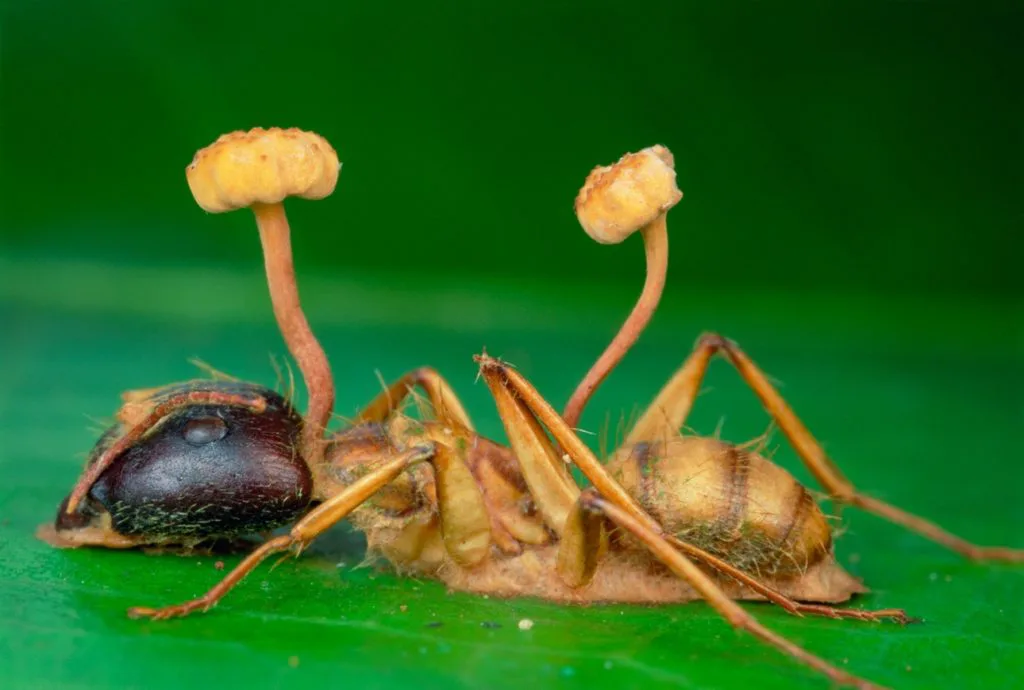
For decades, scientists assumed the zombie ant fungus must flood the ant’s brain with chemicals, taking the controls directly like a hijacker grabbing a steering wheel. The truth, when it finally arrived, was stranger and far more elegant. In a 2017 study published in PNAS, Maridel Fredericksen and colleagues at Penn State examined infected ants in extraordinary detail and found that the brain itself remains largely intact and essentially fungus-free. Instead, the fungal cells wrap themselves around the muscle fibres of the body, especially in the legs and the jaw, forming connected networks that control the ant from the outside, chemically, the way a puppeteer works a puppet purely by pulling strings.
Earlier research had already hinted that the manipulation runs deeper than simple muscle squeezing. In 2014, a team led by Charissa de Bekker showed that the fungus alters the activity of genes linked to the ant’s nervous system and to its biological clock, which may explain why infected ants keep such eerily precise timing later in the infection. Put the two discoveries together and a picture emerges of a parasite that never needs to enter the control room at all. It rewires the machinery around the brain, tunes the host’s sense of time, and lets the ant’s own legs carry it exactly where the fungus needs it to go.
The Death Grip Explained
After roughly a week or two of infection, the puppet strings tighten. The ant abandons its nest and its familiar foraging trails, something a healthy carpenter ant would never normally do, and begins wandering alone across the forest floor, moving erratically and twitching with convulsions as the fungal networks seize more direct control of its muscles. Live Science’s account of zombie ants controlled by fungus captures just how unsettling this stage looks: the ant is still alive, still walking, but the walking is no longer really its own idea, and every shaky step points it towards a low plant stem.
Then comes the act the whole performance has been building towards. Guided upwards, the ant climbs to a spot about twenty-five centimetres above the forest floor and, typically around solar noon, clamps its jaws onto the underside of a leaf vein in a bite it will never release. The zombie ant fungus now makes sure the grip can never be undone: it destroys the connections inside the jaw muscles, so the mandibles lock permanently in place even as the ant dies. Afterwards the fungus preserves the ant’s outer shell, reinforcing it like a suit of armour that protects the body from microbes and rival fungi while the final act develops inside.
Why the Fungus Needs the Perfect Spot
That very particular height, roughly twenty-five centimetres above the ground, is not an accident or a flourish. It is a carefully evolved address. Down on the forest floor it is often too wet, too crowded and too full of hungry scavengers, while high in the canopy the air becomes too dry for delicate fungal growth. In between sits a narrow band where humidity and temperature hold steady at almost exactly the levels the fungus needs to mature, and infected ants reliably deliver themselves to it, frequently biting on the north side of the plant where conditions stay coolest and dampest through the day.
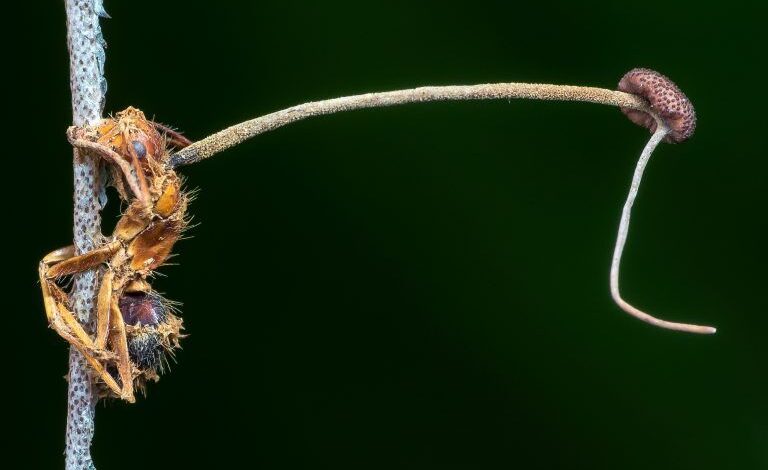
From its leafy perch, the dead ant becomes a launch pad. A few days after the death grip, a pale stalk begins to push out of the back of the ant’s head, growing slowly until it is ready to release a fresh shower of spores. Those spores drift and rain down onto the foraging trails below, which is precisely where healthy carpenter ants walk every single day. One manipulated corpse can therefore seed an entire patch of forest floor with infection, and the ants passing underneath have no way of knowing that the danger is falling silently from a former nestmate suspended above them.
How Ant Colonies Fight Back
Ant colonies, however, are far from defenceless victims in this story, because a society of thousands cannot survive by ignoring disease. Healthy nestmates are remarkably good at spotting workers whose behaviour has turned strange, and they act on it: infected individuals are detected, seized and carried far away from the colony, where they can do no more harm to the group. Biologists call this social immunity, and it works much like a public health system, combining early detection with strict quarantine. Thanks to this constant policing, only a small fraction of infections ever mature close enough to threaten the colony as a whole.
The fungus faces enemies of its own, too, which keeps the whole system in balance. Specialised hyperparasitic fungi attack the zombie ant fungus itself, invading its stalk and crippling its ability to release viable spores, so the puppet master has a parasite of its own pulling its strings. It is an arms race stacked in layers, refined over tens of millions of years. It is also a reminder of how differently animals live their lives: a colony that thinks and defends itself as one organism sits at the far end of the spectrum from the familiar cats-versus-dogs debate about which independent-minded companion animal rules our homes.
Could the Zombie Ant Fungus Ever Infect Humans
It is the question everyone asks, so here is the reassuring answer first: no, the zombie ant fungus cannot infect people, and it is not a matter of luck. This fungus is an extreme specialist, fine-tuned by evolution to the body chemistry, temperature and behaviour of particular carpenter ants. Human bodies run far hotter than an ant’s cool forest world, and this fungus simply cannot survive at our body temperature, let alone grow, spread or manipulate anything inside us. The same specialisation that makes it such a perfect parasite of ants makes it completely harmless to humans, pets and every other warm-blooded animal.
The fear, of course, comes from fiction. This fungus famously inspired the cordyceps outbreak in the game and television series The Last of Us, which imagined a relative of the fungus jumping to humans and collapsing civilisation. It is brilliant storytelling built on a real organism, but scientists are clear that a human pandemic from this fungus is not scientifically plausible: too many biological barriers stand in the way, from temperature to immune systems to the sheer chemical distance between an ant and a person. What the real fungus offers instead is something better than a nightmare, a window into how far evolution can push the relationship between two species.
Frequently Asked Questions
What exactly is Ophiocordyceps unilateralis? It is a parasitic fungus found in tropical forests around the world, first described scientifically in 1859 by Alfred Russel Wallace. It infects carpenter ants, grows through their bodies, manipulates their behaviour so they climb and bite onto vegetation in a perfect growing spot, and then sprouts a spore-releasing stalk from the dead ant’s head. Fossil evidence suggests this behaviour is at least forty-eight million years old, making it one of the oldest and most refined examples of a parasite controlling its host.
Does the fungus really control the ant’s brain? Surprisingly, no, and that is what makes the science so fascinating. Research published in PNAS in 2017 by Fredericksen and colleagues at Penn State showed that the ant’s brain remains largely intact and free of fungal cells. Instead, the fungus builds networks around the muscle fibres, particularly in the legs and jaw, and controls the body chemically from the outside. Earlier work in 2014 also showed it alters genes connected to the ant’s nervous system and body clock, so the control is real, just not where anyone first expected it.
How does an ant become infected in the first place? It starts with a single spore. Spores released from the stalk of a dead, infected ant fall onto the forest floor and the trails below, where foraging carpenter ants pick them up on their exoskeletons. A spore attaches, then forces its way through the tough outer shell using enzymes and mechanical pressure. Once inside, the fungus multiplies, feeds on soft tissues and spreads through the body while avoiding the ant’s immune defences, until it is ready to steer the ant into its final climb and death grip.
Can this fungus infect humans, dogs or cats? No. The fungus is highly specialised for its ant hosts and cannot survive the body temperature of humans or other warm-blooded animals, so there is no risk to you, your children or your pets. The idea of it jumping to people comes from The Last of Us, which borrowed the fungus as inspiration for fiction. Scientists who study the real organism are clear that a human version is not plausible, because the biological gap between an ant’s body and ours is far too wide for this specialist to cross.
How do ant colonies protect themselves against it? Colonies rely on what biologists call social immunity. Worker ants are quick to notice nestmates behaving oddly, and they physically remove infected individuals, carrying them far from the colony before the fungus can mature and release spores nearby. This early detection and quarantine keeps most outbreaks small. The fungus also has enemies of its own: hyperparasitic fungi attack it and reduce its ability to spread, so colonies benefit from a second, invisible layer of defence working on their behalf.
Final Thoughts
The zombie ant fungus endures as one of biology’s great stories because it overturns our assumptions at every turn. We imagine mind control as an invader seizing the brain, yet here is a parasite that leaves the brain untouched and simply takes over the muscles, the timing and the chemistry around it. We imagine the ant as a helpless victim, yet its colony runs a detection-and-quarantine system effective enough to keep the fungus in check, while the fungus itself is hunted by parasites of its own. Every layer of the story contains another, older layer underneath it.
Perhaps that is why this tiny tropical fungus has travelled so far beyond the forest, into documentaries, games and television shows watched by millions. It speaks to a deep human fascination with the question of who is really in control of a living body, and it answers with unsettling elegance: sometimes, not the owner. The good news is that the horror stays where it belongs, in the ant world, at twenty-five centimetres above the forest floor. For us, it remains pure wonder, a reminder that evolution’s strangest inventions are usually already out there, quietly at work, long before we think to imagine them.