










Yes — there was a space launch today. A SpaceX Falcon 9 lifted off from Vandenberg Space Force Base in California at 04:04 UTC (12:04 a.m. Eastern) on Saturday, 31 October 2026, carrying 27 Starlink internet satellites into low Earth orbit. The flight was the 700th Falcon 9 launch in history, and SpaceX’s eleventh and final orbital mission of October. This page reflects the launch schedule as of 31 October 2026 — rocket schedules change often, so treat every time below as a plan, not a promise.
At a Glance: Space Launches Today (31 October 2026)
- One confirmed orbital launch today: SpaceX Falcon 9, Starlink Group 15-18.
- Liftoff: 04:04 UTC / 12:04 a.m. EDT / 9:04 p.m. PDT (Friday evening, California time) — Saturday, 31 October 2026.
- Launch site: Space Launch Complex 4 East (SLC-4E), Vandenberg Space Force Base, California.
- Payload: 27 Starlink V2 Mini Optimized broadband satellites, deployed about 62 minutes after liftoff.
- Milestone: the 700th Falcon 9 launch since the rocket’s first flight in June 2010, according to Spaceflight Now.
- Booster: first stage B1093, flying its 18th mission; it landed on the droneship Of Course I Still Love You about 8.5 minutes after liftoff.
- Next launches: Rocket Lab Electron, a Chinese Kinetica 2, and another SpaceX Falcon 9 (USSF-432) are all listed on public schedules for Monday, 2 November 2026.
What Rocket Launched Today?
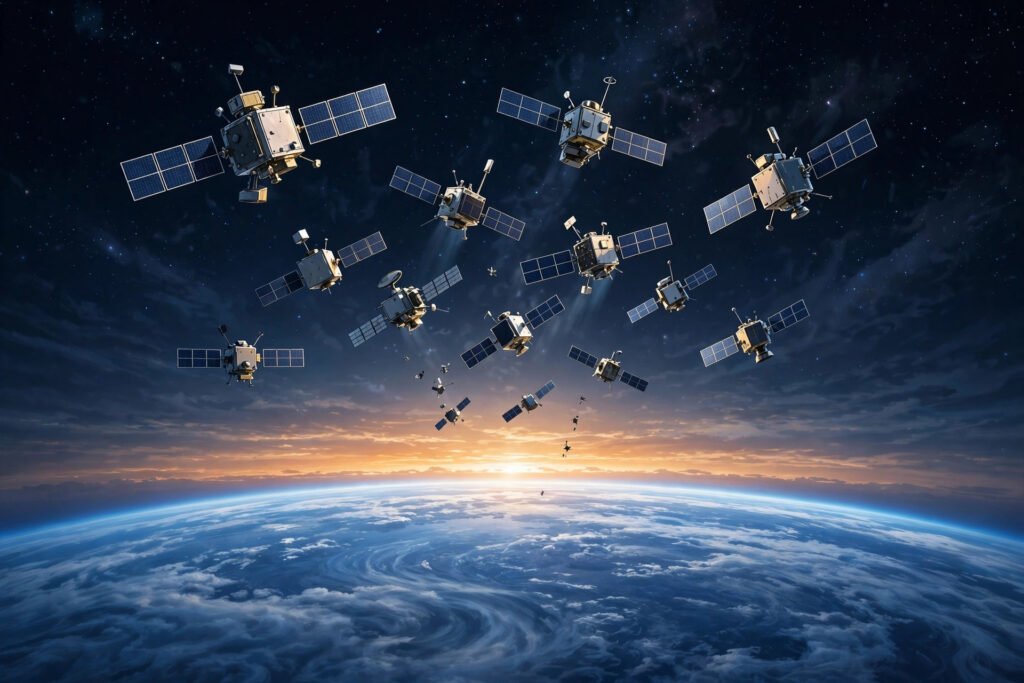
Today’s confirmed launch is Starlink Group 15-18, flown by SpaceX aboard a Falcon 9 Block 5 rocket. It lifted off from Space Launch Complex 4 East at Vandenberg Space Force Base on the California coast at 9:04 p.m. local time on Friday evening — which was already Saturday, 31 October, in UTC and Eastern Time. The rocket flew a southeasterly trajectory out over the Pacific, the standard route for Starlink missions from Vandenberg heading into polar-leaning orbits.
The mission’s payload was a batch of 27 Starlink V2 Mini Optimized satellites — the upgraded version of SpaceX’s broadband internet spacecraft, designed to pack more throughput into the same mass envelope as earlier variants, according to mission reporting. Roughly an hour after liftoff, the Falcon 9’s upper stage released all 27 satellites into low Earth orbit, where they will raise themselves into the constellation’s Group 15 orbital shell. Starlink is SpaceX’s space-based internet network, now the largest satellite constellation ever flown, with more than 11,000 operational spacecraft in orbit according to industry reporting as of October 2026.
The timezone trap — and why it matters
If you are searching “space launch today” from the US West Coast, one honest caveat: in California, this rocket lifted off on Friday evening, 30 October. Everywhere east of the Rockies — and everywhere in Europe, Africa, and Asia — it was Saturday, 31 October. Launch trackers publish in UTC precisely to avoid this confusion, but aggregator sites convert to your local zone and can disagree about which day a launch “belongs” to. When you see two sources list different dates for the same launch, check the UTC time first — it is the only one that is never ambiguous.
Why Was This Launch a Milestone?

Starlink 15-18 was the 700th launch of a Falcon 9 since the rocket’s debut flight in June 2010, a figure reported by Spaceflight Now and confirmed by independent spaceflight trackers. No other orbital rocket family has come close to that flight count: it took SpaceX sixteen years to get there, and the second half of that total arrived in a fraction of the time, because the rocket’s first stage is reusable.
The booster used today, tail number B1093, was flying its 18th mission — its previous flights included the Transporter-16 rideshare, two missions for the US Space Development Agency, and fourteen earlier Starlink batches, according to Spaceflight Now. About eight and a half minutes after liftoff it touched down on the autonomous droneship Of Course I Still Love You, stationed in the Pacific Ocean. That was the 231st landing on that particular vessel and the 675th Falcon booster landing overall — numbers that explain how SpaceX sustains a cadence no expendable rocket could match. The current reuse record belongs to a different booster, B1067, which flew its 37th mission this past August.
The mission also closed out a busy month for SpaceX: it was the company’s eleventh and final orbital launch of October and its 118th Falcon 9 flight of 2026 so far. Behind the milestone lies a turning point, though. Spaceflight Now notes that on 27 October the company’s rolling 365-day launch total dropped below 150 orbital flights for the first time since July 2025 — down from a peak of 171 in December 2025 — as SpaceX begins shifting energy toward Starship, and as Falcon 9 Starlink flights from Florida came to an end in August. The next big test is expected in mid-November: Starship Flight 15 from Starbase, Texas, which SpaceX says will attempt to catch the rocket’s upper stage — a manoeuvre never achieved before.
Is There Any Other Launch Today?
One other mission has appeared on some public schedules with a 31 October date: the second test flight of China’s Long March 12A, a reusable methane-fuelled rocket built by the Shanghai Academy of Spaceflight Technology for the China Aerospace Science and Technology Corporation (CASC), flying from the Jiuquan Satellite Launch Center. Its debut flight earlier this year reached orbit but failed its landing attempt.
As of the time of writing, no launch of Long March 12A Flight 2 on 31 October has been confirmed by any major tracker or press report — the date appears to have been a placeholder, and newer schedules list the flight no earlier than 3 November. We are not counting it as today’s launch, and you should treat any site that does with suspicion. This is exactly how launch misinformation spreads: placeholder dates get scraped, republished as fact, and never corrected.
What Launches Are Coming Next?
Rocket schedules slip constantly — weather, technical checks, and range availability move targets by days — so treat this as the plan as published on 31 October 2026, not a guarantee. All three of Monday’s missions are listed as go for launch on public trackers:
| Date | Rocket | Mission | Site |
|---|---|---|---|
| Mon 2 Nov | Electron/Curie (Rocket Lab) | The Sea God Surveys | Māhia Peninsula, New Zealand |
| Mon 2 Nov | Kinetica 2 (CAS Space) | SpaceSail polar constellation batch | Jiuquan, China |
| Mon 2 Nov | Falcon 9 (SpaceX) | USSF-432 (classified US Space Force payload) | Vandenberg SFB, California |
| Early Nov | Ceres-2 (Galactic Energy) | Undisclosed payload | Jiuquan, China |
| Early Nov | Long March 12 (CASC) | SatNet LEO constellation batch | Wenchang, China |
| Thu 5 Nov | Falcon 9 (SpaceX) | Starlink Group 15-21 | Vandenberg SFB, California |
| Mon 9 Nov | Falcon 9 (SpaceX) | USSF-xxx (undisclosed) | Vandenberg SFB, California |
| Mid-Nov | Starship (SpaceX) | Flight 15 — upper-stage catch attempt | Starbase, Texas |
A few notes on what to expect:
- USSF-432 on Monday evening is a classified mission for the United States Space Force, launching from the same Vandenberg pad as today’s flight at about 6:42 p.m. Pacific (01:42 UTC Tuesday). Classified missions rarely stream the payload portion — expect SpaceX to cut its webcast at stage separation.
- The Sea God Surveys is a Rocket Lab Electron mission from New Zealand, continuing the small-launcher’s steady cadence. Electron has become the workhorse of dedicated smallsat launches, with a reliability record that has made it the default choice for payloads too small to justify a Falcon 9 rideshare.
- SpaceSail (Qianfan) is China’s answer to Starlink — a planned megaconstellation of thousands of broadband satellites. The Kinetica 2 flight on Monday would add another polar-orbit batch.
- Further out, Cygnus CRS-2 NG-25 — Northrop Grumman’s cargo resupply flight to the International Space Station, flying on a Falcon 9 — is expected in about four weeks, and China’s Shenzhou 24 crewed mission is listed for roughly the same window.
What launched yesterday?
For context, 30 October was a busy launch day worldwide. India’s space agency, ISRO, launched NVS-03 — a navigation satellite for the NavIC regional system — aboard a GSLV Mk II rocket from the Satish Dhawan Space Centre at 18:21 UTC. Earlier in the week, China flew a Long March 8A and a Long March 4B carrying six payloads, and SpaceX flew Starlink Group 15-16 on 27 October. Eight orbital launches flew worldwide in the week of 18–25 October, and all eight reached their intended orbits.
How Can You Watch a Rocket Launch Live?
Whether a launch is worth watching depends on where you are and what is flying:
- Vandenberg launches like today’s are visible along the California coast on clear nights — the rocket’s exhaust plume catching the sun just after sunset or before sunrise produces the famous “twilight phenomenon” that gets photographed across the Southwest. Daytime launches are harder to spot from a distance.
- SpaceX streams its launches on its own website and social channels; coverage typically starts about 15 minutes before liftoff and, for classified missions, ends at stage separation.
- Rocket Lab streams Electron launches on its website with commentary aimed at a general audience — these are among the most watchable launches in the industry.
- Chinese launches almost never have official English-language livestreams; footage usually surfaces on social media minutes after liftoff.
If you missed today’s launch, highlight reels from the Starlink 15-18 flight — including the booster’s droneship landing — were circulating within hours on the usual spaceflight channels.
How Do I Check the Launch Schedule Myself?
The single most important habit for following launches: check the day of, not the week of. Scrub rates are high — today’s target time of 03:48 UTC slipped to 04:04 UTC before liftoff, a routine move inside the window that a week-old article would have gotten wrong. Two independent trackers worth bookmarking are Spaceflight Now’s mission pages and the RocketLaunch.Live launch schedule, both of which update in near real time. SpaceX also publishes its own manifest, and NASA covers its missions in detail. Be wary of calendar-scraper sites that list placeholder dates (like the unconfirmed Long March 12A entry discussed above) as firm launches — if a launch has no named source, it is a rumour.
SpaceX is the company run by Elon Musk, who also runs Tesla — our Tesla Model Y guide covers the electric-car side of his empire.
Was there a space launch today, 31 October 2026?
Yes. A SpaceX Falcon 9 launched the Starlink Group 15-18 mission from Vandenberg Space Force Base in California at 04:04 UTC (12:04 a.m. Eastern) on Saturday, 31 October 2026, carrying 27 Starlink internet satellites to low Earth orbit. The launch was successful, and the booster landed on a droneship in the Pacific.
What time did the rocket launch today?
Liftoff was at 04:04 UTC on 31 October 2026 — that is 12:04 a.m. Eastern, 11:04 p.m. Central, 10:04 p.m. Mountain, and 9:04 p.m. Pacific on Friday, 30 October in California local time. In the UK it was 4:04 a.m. Saturday morning. Launch times are always published in UTC to avoid exactly this kind of confusion.
Why is today’s SpaceX launch significant?
It was the 700th Falcon 9 launch since the rocket’s first flight in June 2010 — a flight count no other orbital rocket has approached. The booster, B1093, flew its 18th mission and landed successfully, marking the 675th Falcon booster recovery. The flight was also SpaceX’s eleventh and final orbital launch of October 2026.
When is the next SpaceX launch?
The next SpaceX launch on public schedules is USSF-432, a classified mission for the US Space Force, targeting Monday, 2 November 2026 at about 6:42 p.m. Pacific (01:42 UTC Tuesday) from Vandenberg’s SLC-4E — the same pad used today. It is followed by Starlink Group 15-21 on Thursday, 5 November. Schedules change frequently, so re-check on launch day.
Where can I find a reliable rocket launch schedule?
Use trackers that update in near real time and cite their sources, such as Spaceflight Now’s mission pages, the RocketLaunch.Live schedule, or SpaceX’s own manifest for its flights. Avoid sites that list placeholder dates as confirmed launches, and always re-check the schedule on launch day — scrubs and time changes are routine.
