







Introduction
Manufacturing across the Gulf Cooperation Council (GCC) is growing fast. Food and beverage plants, pharmaceutical facilities, petrochemical complexes, steel mills and electronics factories are all expanding as countries like the UAE and Saudi Arabia diversify beyond oil. Almost every one of these operations depends on a reliable supply of clean, process-grade water.
The challenge is that the GCC is one of the most water-scarce regions on earth. Raw water is often salty, hard or high in dissolved solids, and municipal supply is largely produced by desalination. For manufacturers, untreated water is not just a quality issue. It damages equipment, wastes energy, raises costs and puts compliance at risk.
In this article, we explain why industrial water treatment is essential for GCC manufacturers, which systems matter most, and how working with experienced Water Treatment Equipment Suppliers helps companies protect their operations and their bottom line.
The GCC Water Challenge for Manufacturers
The region has very little natural fresh water. Rainfall is low, rivers are absent and groundwater is often brackish or over-extracted. As a result, GCC countries rely heavily on desalinated seawater for both domestic and industrial use.
For a factory, this creates several problems:
- High salinity and hardness: Groundwater and some supply sources carry high levels of calcium, magnesium, chlorides and total dissolved solids (TDS).
- Variable quality: Feed water can change with season, source and temperature, making consistent production harder.
- High cost of water: Producing and transporting fresh water in a desert climate is expensive, so wasting it hits margins directly.
- Strict regulations: Authorities across the GCC are tightening rules on industrial discharge and water reuse as part of long-term sustainability goals.
In this environment, treating water properly is not an optional upgrade. It is a basic requirement for running a stable, profitable manufacturing operation.
6 Reasons Industrial Water Treatment Is Essential
1. Protecting Equipment from Scale and Corrosion
Hard, mineral-rich water leaves scale inside boilers, cooling towers, heat exchangers and pipework. Even a thin layer of scale acts as insulation, forcing equipment to work harder and use more fuel. Chlorides in untreated water also cause corrosion, which leads to leaks, breakdowns and expensive replacements. Proper softening, filtration and reverse osmosis prevent these problems at the source.
2. Ensuring Consistent Product Quality
In many industries, water is an ingredient or a critical process input. Beverage producers need water with stable taste and mineral content. Pharmaceutical plants require purified water that meets strict pharmacopoeia standards. Electronics and chemical manufacturers need ultra-pure water free of ions and particles. Any variation in water quality can mean rejected batches, product recalls and damaged brand reputation.
3. Reducing Energy and Operating Costs
Clean water keeps systems running efficiently. Scale-free boilers and heat exchangers transfer heat better, which lowers fuel and electricity use. Well-treated feed water also reduces the need for chemical dosing, cleaning cycles and unplanned maintenance. Over the life of a plant, these savings often far exceed the cost of the treatment system itself.
4. Minimising Downtime
In manufacturing, every hour of unplanned shutdown costs money. Fouled membranes, blocked nozzles and failed boilers can halt an entire production line. A reliable treatment system, backed by fast access to spare parts and replacement components, keeps lines running and protects delivery schedules.
5. Meeting Environmental and Regulatory Requirements
GCC governments are placing more emphasis on water conservation and responsible discharge. Manufacturers are expected to treat wastewater before releasing it and, increasingly, to recycle it back into the process. Effective treatment helps companies stay compliant, avoid penalties and support national sustainability targets.
6. Enabling Water Reuse and Sustainability
With water so expensive to produce in the region, reusing it makes strong financial sense. Modern systems can treat process wastewater or cooling tower blowdown to a standard suitable for reuse. This reduces fresh water demand, lowers utility bills and strengthens a company’s environmental credentials with customers and investors.
Core Treatment Systems and Why Supplier Choice Matters
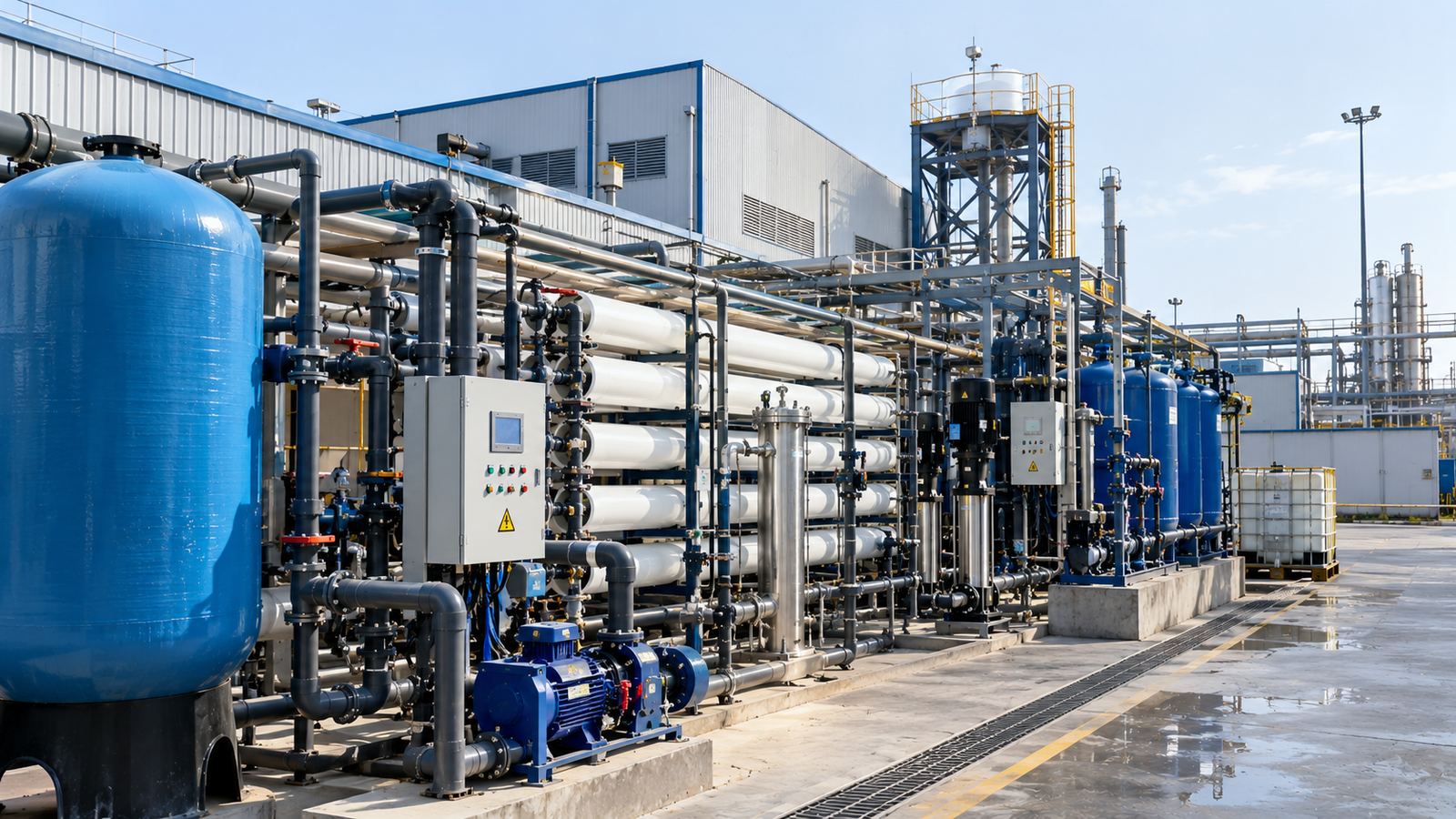
Most industrial water treatment setups in the GCC combine several stages, each tailored to the raw water and the end use.
- Multimedia and sand filtration: Removes suspended solids, turbidity and larger particles as a first line of defence.
- Activated carbon filters: Remove chlorine, odour and organic compounds that can damage membranes or affect product taste.
- Water softeners: Exchange calcium and magnesium for sodium to prevent scale in boilers and cooling systems.
- Reverse osmosis (RO): Removes up to 99 percent or more of dissolved salts, producing high-purity water for process, boiler feed or product use.
- Dosing and monitoring: Chemical dosing, flow meters and TDS or pH controllers keep the system stable and give operators real-time data.
Reverse osmosis is the heart of most modern systems, and its performance depends heavily on the membranes. Working with established RO Membrane Suppliers in UAE gives manufacturers access to proven brands, the right membrane type for their feed water and quick replacements when elements reach the end of their life.
Filters and membranes also need strong, reliable housings. Fibreglass reinforced plastic (FRP) vessels are widely used for multimedia filters, carbon filters and softeners because they resist corrosion, handle pressure well and need little maintenance. A dependable FRP Vessels Supplier ensures each vessel is correctly sized and rated for the job, which protects the media inside and prevents leaks.
When selecting Water Treatment Equipment Suppliers, manufacturers should look for certified products, local stock for fast delivery, technical support for system design and a complete range of components from one source. This reduces procurement complexity and ensures every part of the system works together.
Conclusion
For manufacturing companies in the GCC, water is both scarce and critical. Untreated water damages equipment, wastes energy, threatens product quality and creates compliance risks. A well-designed industrial water treatment system turns that risk into a reliable, cost-effective resource.
The key is to invest in the right technology and the right partners. Quality RO membranes, durable FRP vessels and properly matched filtration and dosing equipment keep production running smoothly for years. As the region’s industries continue to grow, companies that take water treatment seriously today will be the ones best placed to compete tomorrow.
Frequently Asked Questions (FAQs)
1. What is industrial water treatment?
It is the process of cleaning raw water so it is suitable for manufacturing use, such as boiler feed, cooling, cleaning or as a product ingredient. It also covers treating wastewater before discharge or reuse.
2. Which industries in the GCC need water treatment the most?
Food and beverage, pharmaceuticals, petrochemicals, power generation, textiles, steel and electronics all depend heavily on treated water. In practice, almost every manufacturing plant needs some level of treatment.
3. Why is reverse osmosis so widely used in the region?
GCC water sources are often high in dissolved salts. RO is one of the most effective and energy-efficient ways to remove these salts and produce consistent, high-purity process water.
4. How long do RO membranes last in industrial systems?
With good pre-treatment and regular cleaning, industrial RO membranes typically last 3 to 5 years. Poor feed water or irregular maintenance can shorten their life.
5. What are FRP vessels used for in water treatment?
FRP vessels house filter media for multimedia, carbon and softener systems, and can also hold RO membranes. They are popular because they are corrosion-resistant, lightweight and low-maintenance.
6. How do I choose the right water treatment equipment supplier?
Choose a supplier with certified products, local stock, technical support and a full range of components. Ask about their experience with your industry and the after-sales service they offer.