









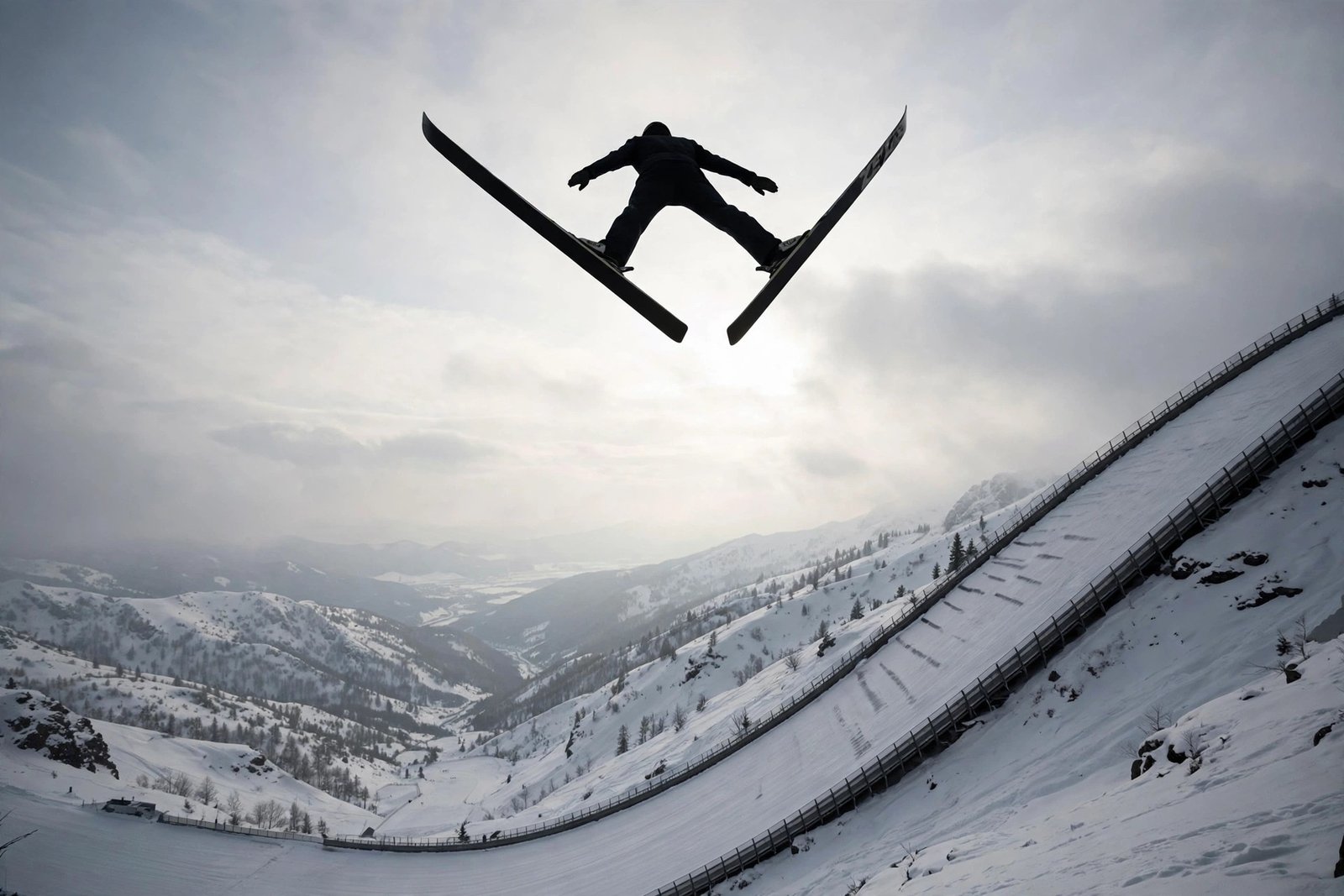
Ski jumpers stay in the air so long because they do not simply fall — they glide. After leaving the take-off at around 90 km/h, a jumper leans forward over skis spread in a V-shape so the body and skis together act as a wing, generating lift that slows the descent, while the landing hill falls away beneath them at almost the same angle as their flight path. As of October 2026, that combination — speed, lift and a hill built to follow the jumper — is still the whole explanation, and the training behind it is year-round work on smaller hills, summer plastic hills, in the gym and, for some teams, in a wind tunnel.
It looks like defying gravity. It is managing gravity, for about five to seven seconds at a time.
At a Glance
- They glide, they do not fly: Lift slows the fall but never cancels gravity completely, according to the Smithsonian Science Education Center and Scientific American.
- Take-off speed: Around 90 km/h (56 mph) on a typical hill, per the Smithsonian Science Education Center; about 95 km/h on large hills, per FIS hill data.
- Time in the air: About 5 to 7 seconds on a large-hill jump, according to Clemson University physicist Amy Pope speaking to NPR in February 2022.
- Height above the ground: Far less than it looks on TV — the Smithsonian notes jumpers are never more than about 10 to 15 feet (roughly 3 to 4.5 metres) above the landing slope.
- The V-style: Pioneered by Swedish jumper Jan Boklöv in the mid-1980s; he won in Lake Placid on 10 December 1988 using it, according to the International Ski and Snowboard Federation (FIS), and by the early 1990s it had replaced the parallel style completely.
- Distances: A normal hill has a K-point of 75–99 metres and a large hill a K-point of 100–130 metres, under the FIS hill classification.
- Training: Summer jumping on porcelain in-run tracks and watered plastic landing mats, explosive gym work built around squats and imitation jumps, gradual progression from small hills upward, and wind-tunnel sessions where teams have access to them.
Are Ski Jumpers Really Flying?
No. A bird or aircraft can generate enough lift to climb. A ski jumper never does. What the jumper generates is enough lift to fall much more slowly than a stone would, while travelling forward very fast.
The Smithsonian Science Education Center describes three forces in flight: lift, drag and weight. Lift pushes up, gravity pulls down, drag slows the jumper. Lift is always smaller than weight, so the jumper always descends — but at motorway speed, that descent stretches over more than 100 metres. Clemson physicist Amy Pope told NPR at Beijing 2022 that a basketball player stays airborne about a second, while ski jumpers manage 5 to 7 seconds: not jumping higher, falling slower, on purpose.
How Does the Jump Start? The In-Run and Take-Off
The in-run: trading height for speed
Every jump begins on a start bar atop the in-run, the steep ramp that converts height into speed. The Smithsonian describes potential energy becoming kinetic energy on a ramp of about 35 degrees, jumpers crouching low with arms behind the body to minimise drag, reaching around 90 km/h (56 mph) at take-off.
USA Ski Jumping adds a coaching detail viewers miss: a good in-run is balanced and relaxed, upper body roughly parallel to the slope, knees forward, balance through the middle of the foot, completed in about 3 to 4 seconds depending on hill size. Any extra drag in that crouch is distance lost before the flight has begun. Modern in-runs help fairness too: the Smithsonian notes ceramic tracks with cooling holding a stable ice layer of about 20 mm.
The take-off: a jump downwards, timed to a fraction of a second
Here is the first thing television gets wrong: the take-off table does not point up. According to the Smithsonian Science Education Center, the end of the ramp is angled down by about 10.5 degrees. The jumper does not slide off and hope. In a fraction of a second, the jumper extends explosively from the crouch, launching up and forward at the exact moment the skis leave the table.
USA Ski Jumping stresses timing is everything: extend too late and the skis point up, too early and they point down. Peer-reviewed biomechanics reporting puts the whole extension at roughly a quarter to a third of a second — the movement jumpers rehearse thousands of times on dry land.
What Is the V-Style, and Why Did It Replace Parallel Skis?
Before the late 1980s, jumpers flew with skis parallel, in the Däscher style. As of October 2026, every elite jumper spreads the tips wide, tails close, into a V.
The change came from Sweden’s Jan Boklöv. According to FIS, he discovered it by accident in the mid-1980s when a fluffed training jump tore his skis apart — and he flew about 20 metres further than usual. Judges at first marked him down for style. That changed on 10 December 1988, when FIS records Boklöv winning in Lake Placid, New York, in the V. The Smithsonian reports the V produces about 30% more lift than the parallel position; FIS notes that by the early 1990s it had prevailed completely.
Biomechanics research has since refined how wide the V should be. Wind-tunnel work by Seo and colleagues, reviewed in peer-reviewed flight-phase research, found a ski-opening angle of around 26 degrees best balanced reducing drag early in flight with maximising lift later. The V is not “as wide as possible” — it is a measured angle, adjusted through the flight.
For another elite athlete whose body, training and career are explained in depth, see our explainer on Ronnie Coleman.
How Do the Body and Skis Work as a Wing?
Once the V is set, the jumper leans forward until body and skis form one low, wide wing: air deflected downwards pushes the system up — lift. Scientific American (February 2026) describes jumpers aligning body and skis nearly parallel to the ground, skis in a V just outside the body line, maximising the lifting surface and angle of attack.
Angle of attack — the angle between the wing (skis and body) and the oncoming air — is the jumper’s throttle and brake in one. Too flat means little lift; too steep means drag surges and lift collapses. Peer-reviewed wind-tunnel research (Virmavirta and Kivekäs) found the best lift-to-drag ratio at a ski angle of attack of around 30 degrees, and flight reviews describe the pattern coaches teach: keep the angle low early to protect speed, then increase it later to squeeze out lift as speed falls — micro-adjustments with hands, head and hips for the whole glide.
Equipment is policed to support that wing without turning it into an unfair sail. Under the FIS Specifications for Competition Equipment, maximum ski length is 145% of the competitor’s height, on a minimum body mass index (BMI) of 21 for men and women; below that BMI, shorter skis are required in graded steps, and the ski is 95–105 mm wide at the balance point. The BMI link, introduced by FIS in 2004 (Virmavirta and Kivekäs), was a health measure — it removed the reward for dangerous weight loss. Suits are controlled too: NBC Olympics, summarising FIS rules, notes one spongy microfibre material, 4–6 mm thick, with regulated air permeability. A 2025 study in Frontiers in Sports and Active Living, reported by Scientific American, found one extra centimetre of suit circumference could add 3.2 metres — why enforcement is so strict.
Why Don’t They Just Fall Straight Down? The Hill Is Part of the Trick
The second television illusion is height. As the Smithsonian explains, ski jumpers are never more than 10 to 15 feet above the ground during flight — they follow the hill’s curve, landing about 100 metres from the ramp on a normal hill.
The landing slope curves away under the flight path, following the profile a jumper actually travels. Instead of falling onto flat ground, the jumper descends along a slope dropping almost as fast as they do, meeting snow travelling in roughly the same direction — a controlled meeting of two similar angles, with bent knees in the Telemark landing (one foot ahead of the other) absorbing the rest, per the Smithsonian and Team GB. Land too far, past where the slope flattens, and that safe geometry disappears — one reason officials lower the start gate in dangerous conditions.
How far, how fast, how long? Normal hill vs large hill
Under the FIS classification, a normal hill has a K-point of 75–99 metres and a hill size of 85–109 metres; a large hill has a K-point of 100–130 metres and a hill size of 110–149 metres. As a concrete example, Team GB’s guide to the Milano Cortina 2026 Games lists the K-point at 98 metres for the normal hill and 128 metres for the large hill used there.
At around 90–95 km/h — roughly 25 metres per second — covering 130–140 metres takes, in round terms, the 5 to 7 seconds Pope cites to NPR. The time is the distance, flown at that speed, on a path the hill was built to match. The ski flying hills (hill size over 185 metres) behind 240–250-metre-plus viral clips are a different discipline.
What Do Wind and Gate Compensation Actually Do?
A headwind adds lift, a tailwind removes it — without correction, ski jumping would be a weather lottery. FIS therefore measures wind and adjusts the score.
A peer-reviewed meta-analysis in PLOS ONE explains it: FIS introduced wind compensation in January 2010, revised in 2016, using a weighted average from sensors at typically 5 points on normal hills, 7 on large hills and 10 on ski flying hills. Headwind help means points deducted; tailwind hindrance means points added. Gate compensation works alongside it: a higher start gate means a longer in-run and more speed, so if the gate changes mid-round, points are deducted for a higher gate and added for a lower one (NBC Olympics). Together they let officials shorten the in-run for safety without restarting the competition.
How Do Ski Jumpers Train for That?
Nobody learns this at 130 metres. Training has four layers: start small, jump all year, build explosive take-off power, and rehearse flight anywhere possible — including in moving air.
They start on tiny hills and earn each bigger one
Progression by hill size is the first safety rule. Ski Jumping Canada’s development plan places children aged roughly 7–9 on K18/K38 or K20/K40 hills — a fraction of Olympic size — and Whistler Olympic Park’s beginner programme for ages 8 to 14 likewise starts on 20- and 40-metre junior hills. Take-off mechanics are the same at every size, so a movement learned at 20 metres still works at 120.

They jump in summer, on porcelain and plastic
FIS’s preview of the Summer Grand Prix — run for men since 1994, with a women’s tour added in 2012 — describes the summer set-up: porcelain (ceramic) in-run tracks and plastic matting on the landing hill, kept wet so skis slide much as on snow. The point is repetitions: winter-only jumping would give a fraction of the practice.

They train the take-off in the gym: squats, plyometrics and imitation jumps
The gym work is specific, because the take-off is specific. Peer-reviewed research in PLOS ONE describes two staples used to measure and train it: the squat jump, from a stationary squat with hands on hips, and the ski jump imitation (IMIT) — starting from the in-run crouch, then jumping to maximise vertical lift with enough forward momentum to finish in a flight position, caught by a coach. A case study of an Olympic Nordic combined champion in Frontiers in Physiology records roughly 90–140 hours per season of general strength/power work, with imitation jumps rising steadily and a later focus on high-velocity specific movements, ankle flexibility and hip/core control. In short: squats for force, plyometrics to deliver it in a fraction of a second, core and balance work to hold position. No federation publishes one universal routine — programmes are individualised, so treat any “exact ski jumper workout” listicle with suspicion.
They practise flying without a hill: wind tunnels and video
A hill gives seconds of flight per attempt; a tunnel gives minutes. FIS reported the Austrian Nordic combined team using the Rail Tech Arsenal wind tunnel in Vienna, where flights could last up to two minutes, with a coach instructing during flight, to fine-tune position and test equipment. The Steamboat Springs Winter Sports Club likewise reported a specialised ski jumping tunnel at its 2026 EuroCamp, its angle adjustable to replicate a landing hill, with coaches seeing technique improvements on the hill the next day. Tunnel work supplements, never replaces, hill jumping — and the universal tool alongside it is video review, since athletes cannot see their own V angle or take-off timing.
Frequently Asked Questions
How long do ski jumpers actually stay in the air?
About 5 to 7 seconds on a large hill (Amy Pope to NPR, 2022). USA Ski Jumping gives about 4 to 5 seconds, fitting smaller hills.
How fast do ski jumpers go?
Around 90 km/h (56 mph) at take-off on a typical hill (Smithsonian), about 95 km/h on large hills.
Why do ski jumpers lean so far forward?
To turn body and skis into a single lifting surface — that flat, wide, near-parallel shape is the wing.
What is the V-style in ski jumping?
Ski tips spread wide, tails close, forming a V. Pioneered by Jan Boklöv in the mid-1980s, proven by his Lake Placid win on 10 December 1988 (FIS), it gives about 30% more lift than the parallel style (Smithsonian).
Why doesn’t landing break their legs?
They stay only 10 to 15 feet above a slope curving away beneath them (Smithsonian), meeting snow at a shallow angle and absorbing force with bent knees in the Telemark position.
How do ski jumpers train in summer without snow?
On porcelain in-run tracks and watered plastic landing mats — the FIS Summer Grand Prix set-up, held for men since 1994 — plus imitation jumps, gym work and wind tunnels.
Do ski jumpers get points added or taken away for wind?
Yes. Since January 2010 (PLOS ONE), FIS sensors measure wind per jump: points deducted for helpful headwind, added for hindering tailwind. Gate compensation separately adjusts for a moved start gate.
Sources: FIS equipment specifications and FIS reporting on Boklöv and the Summer Grand Prix; Smithsonian Science Education Center; Scientific American; NPR (Amy Pope, Clemson University); USA Ski Jumping; Team GB; NBC Olympics; peer-reviewed research in PLOS ONE, Frontiers and wind-tunnel flight-phase studies. Rules as of October 2026.