








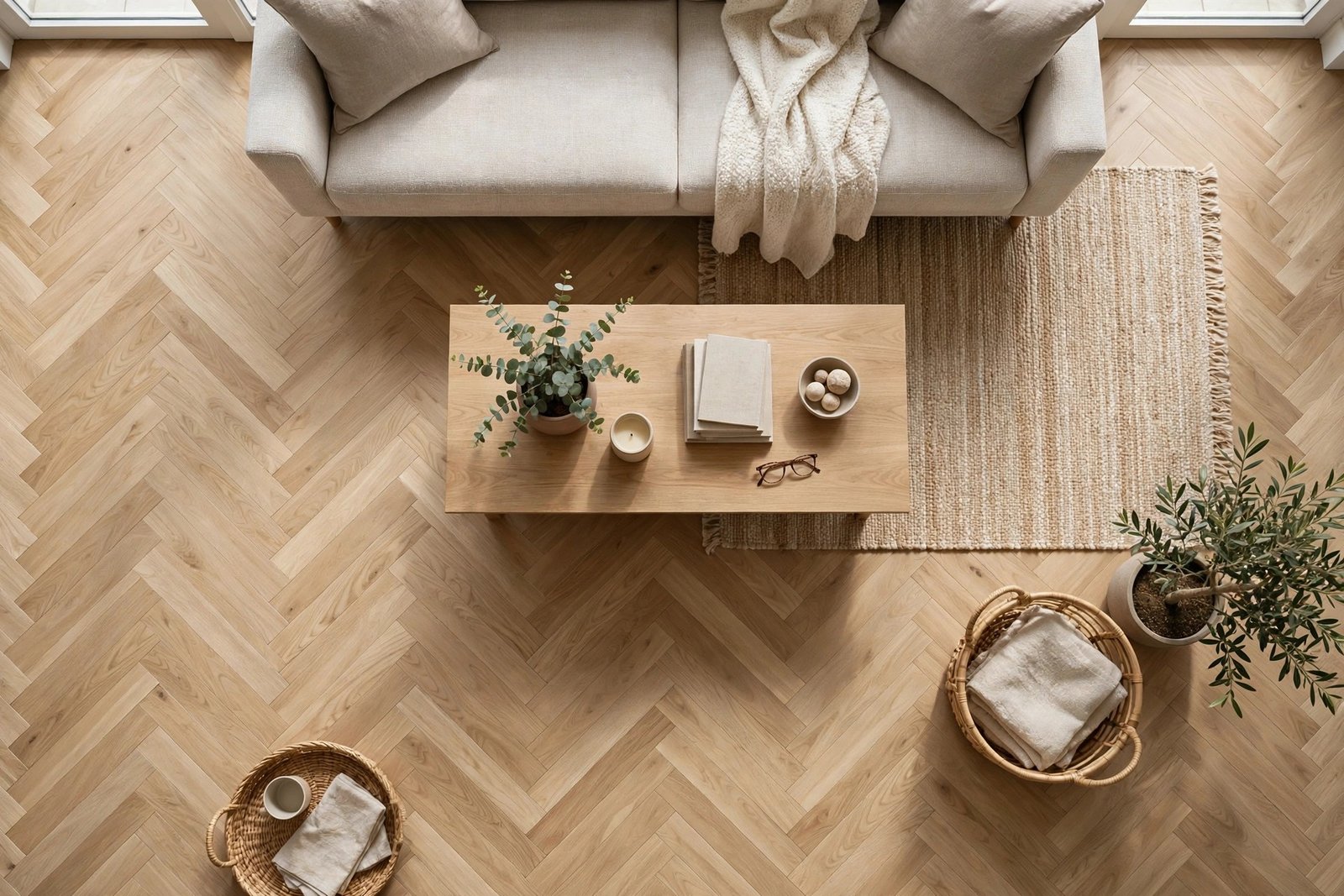
Herringbone laminate flooring is short laminate blocks laid so the end of one block meets the side of the next at 90 degrees, creating a broken zigzag that imitates wood parquet. It is not real wood — each block is a printed design under a hard wear layer, over a high-density fibreboard (HDF) core — and, as of October 2026, it is sold as dedicated click-lock herringbone blocks, not standard planks you cut down. Expect higher fitting cost than straight laminate, and 15–20% extra material for waste.
At a Glance
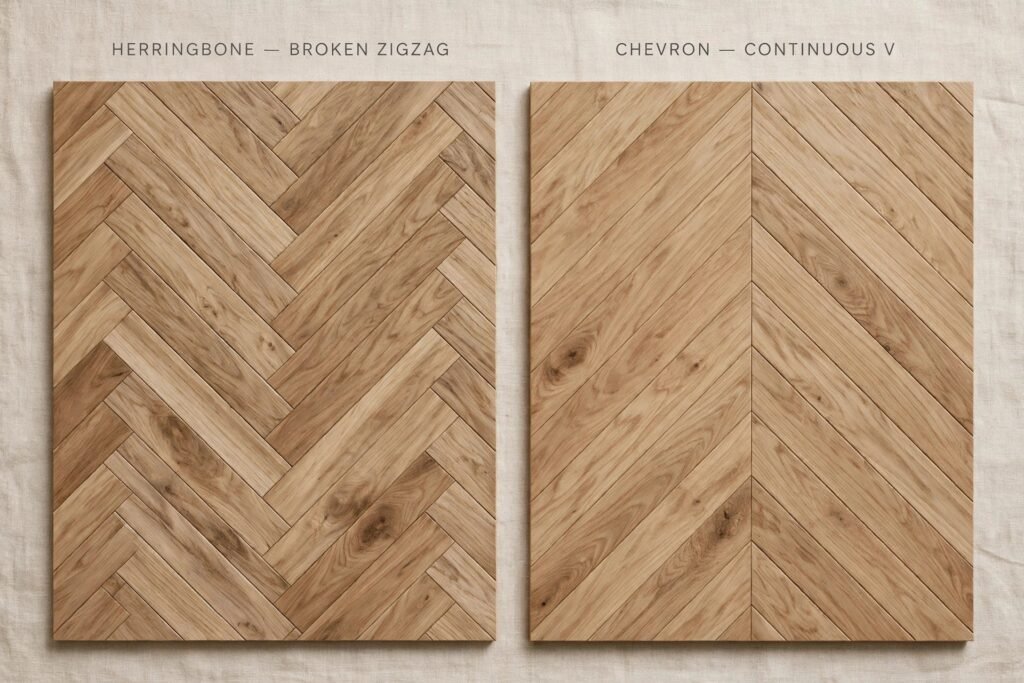
- Pattern: Rectangular blocks at 90 degrees — a staggered, broken zigzag. Not chevron (angle-cut blocks meeting point-to-point in a continuous V).
- Construction: Four layers — wear layer, printed décor layer, HDF core, backing layer.
- Format: Dedicated blocks, typically 470–840 mm long. Most use paired A/B (L/R) blocks; Quick-Step Unizip uses one block type.
- Durability: AC4 for busy homes, AC3 for lighter rooms. AC is an EN 13329 abrasion rating — it says nothing about water.
- Thickness: 8 mm is most common; 12 mm is the premium, more solid-feeling option.
- Water: Most laminate is water-resistant, not waterproof. Only specific ranges are marketed as watertight, on their own warranty terms.
- Waste: Extra 15–20% for herringbone, vs about 10% straight (Topps Tiles fitting guidance).
- Cost, Oct 2026: UK — Tapi: £32.99 per m² material, £28.50 per m² fitting. US — Modernize: $5–$10 per sq ft installed for mid-range laminate, plus $1–$3 per sq ft for herringbone labour.
What Is Herringbone, Exactly?
Herringbone is a pattern, not a material — named for a herring fish skeleton, used in Roman brickwork and later European parquet.
Every piece is a plain rectangle with square-cut ends. Place the short end of one against the long side of the next, at exactly 90 degrees, and repeat in alternating directions — a stepped zigzag with no long unbroken line.
Because every joint turns a corner, a small early error compounds quickly, so herringbone is laid from a centre line outwards, not from a wall.
How Is Herringbone Different From Chevron?
This is the category’s most common confusion. According to Quick-Step’s official herringbone laminate guide, herringbone uses straight rectangular boards meeting at a right angle for a broken, staggered zigzag, while chevron planks are angle-cut to form a clean, continuous V.
- Herringbone: square ends, blocks overlap in a stagger, classic and textured in feel.
- Chevron: mitred ends, usually cut at 45 or 60 degrees, blocks meet point-to-point, sharper and more directional in feel.
How Is Laminate Flooring Constructed?
Laminate is a layered product. The North American Laminate Flooring Association (NALFA) standard LF-01 describes the same build European makers use — backing, core, printed décor and wear layers. From top to bottom:
- Wear layer. Clear melamine resin with aluminium oxide. The surface you walk on; it resists abrasion, stains and fading, and is what the AC rating measures.
- Décor layer. A high-resolution printed image of wood (occasionally stone) on resin-impregnated paper. This is the entire visual effect — there is no real wood veneer.
- Core layer. High-density fibreboard: wood fibres bonded with resin under heat and pressure. It gives strength, and its edges are milled into the click profile. It is also the most water-vulnerable layer — wood fibre swells when wet.
- Backing layer. Resin-impregnated underside. It keeps the block flat and adds a first barrier against subfloor moisture.
That build explains laminate’s limits as well as its strengths: a hard printed surface, a strong but moisture-sensitive core, and no sanding or refinishing — the “wood” is only a printed image.
What Herringbone Laminate Can You Actually Buy?
As of October 2026, manufacturers sell herringbone laminate in two click systems:
1. Paired A/B (or L/R) blocks. The traditional, most common format. A pack contains two mirror-image types, because a block that turns left cannot also turn right once its click profile is milled. Kronotex herringbone, for example, uses 665 × 133 mm blocks in A and B types, 8 mm thick, AC4. Topps Tiles describes the same principle as L/R: planks are marked L or R, sorted into piles, and always installed in pairs. Typical blocks are roughly 95–168 mm wide and 470–840 mm long — EGGER’s NatureSense Herringbone is listed at 840 × 168 × 8 mm — because the pattern only works if length is an exact multiple of width.
2. Single-block systems. Quick-Step’s Unizip uses one plank type that clicks on both sides, which the manufacturer says is faster, easier to handle and lower-waste than A/B. Its Impressive Design Herringbone data sheet (valid from March 2026) lists an 8 mm block, Unizip joint, use class 32 and AC4.
Can You Cut Standard Planks Into Herringbone?
No — not in a way that preserves a working floor, and no major manufacturer recommends it. Cutting a standard plank to herringbone length cuts through its click profile, so the end will not lock, and a warranty will not cover the altered floor. Choose a dedicated herringbone range instead.
Which AC Rating Do You Need — AC3 or AC4?
AC stands for Abrasion Class, from the EN 13329 abrasion test, where a wheel is run over the surface for set cycles. The Floor Covering Reference Manual’s summary of EN 13329 and NALFA testing lists the EPLF thresholds: AC3 at least 2,500 cycles, AC4 at least 4,000, AC5 at least 6,500.
- AC3 — heavy domestic. Bedrooms, dining rooms and lighter living rooms.
- AC4 — general commercial standard, and the default for a hall, kitchen or busy family room. Most UK herringbone ranges as of October 2026, including Kronotex and Quick-Step above, are AC4 / use class 32.
- AC5 — heavy commercial. Extra surface life, but it does not fix a weak core or bad installation.
AC measures surface abrasion only — not dent resistance, locking strength or water resistance. Check the use class too: class 32 is what most quality herringbone carries, and what a warranty refers to.
How Thick Should Herringbone Laminate Be?
Most herringbone laminate is 8 mm; 12 mm is the premium tier. An 8 mm floor is lighter and cheaper but less forgiving — short blocks telegraph subfloor dips more than long planks. A 12 mm floor feels more solid and quieter. Neither substitutes for a flat subfloor, and a 12 mm AC3 floor will wear sooner in a hall than an 8 mm AC4 floor. Compare thickness and AC together.
Is Herringbone Laminate Waterproof?
Read the specific range’s claim word for word — “waterproof” has no single industry meaning for laminate:
- Standard laminate: no claim beyond spill resistance. Water left in joints can reach the HDF core and cause irreversible swelling.
- Water-resistant laminate: water-repellent coating and tighter or wax-sealed joints. Tolerates splashes and damp mopping better, for a limited time set in the warranty. Still an HDF-core floor.
- Marketed waterproof / watertight: a branded claim for specific ranges. Quick-Step attributes its claim to a sealed joint, Hydroseal coating and Unizip, with a 15-year waterproof surface warranty in its data sheet. Pergo’s US WetProtect ranges are similar — spill and wet-mopping protection, conditional on steps including perimeter silicone sealing.
None of those claims means a floor can be flooded, left under a leaking appliance, or steam-cleaned. Floods and long-standing water are excluded in the warranties to check before a kitchen or bathroom installation. For a regularly wet room, tile or rigid-core vinyl is safer.
For another home-material choice explained in depth, see the site’s explainer on the 3D printed house.
What Underlay and Subfloor Preparation Does It Need?
Herringbone laminate floats: blocks click together on underlay, with no glue or nails to the subfloor. Three requirements decide whether it stays flat and quiet.
Flatness comes first. Quick-Step’s herringbone installation instructions require a wooden subfloor flat to within 2 mm over 1 metre, and say unevenness over 4 mm over 2 metres must be rectified first, with levelling compound or a plywood/OSB levelling floor. Herringbone needs this more than straight laminate: a dip a long plank would bridge can open a 90-degree joint or make it click underfoot. Check with a long straightedge before opening a pack.
Underlay is required unless pre-attached. On concrete, use an underlay with a damp-proof membrane or a separate vapour barrier. For underfloor heating, use a low-tog underlay and confirm the range is approved — Quick-Step caps floor surface temperature at 27°C. Never use carpet underlay: it is too soft and lets click joints flex and fail.
Expansion gap and acclimatisation. Leave the gap in the range’s instructions — commonly around 8–10 mm — at walls and fixed objects, covered by skirting or scotia fixed to the wall, never the floor. Store unopened packs flat in the room for at least 48 hours before fitting, as Quick-Step and Topps Tiles instruct.
How Much Extra Should You Order for Waste?
Topps Tiles’ fitting guide says to plan an extra 15–20% for herringbone cutting waste, depending on room shape. Modernize’s 2026 US guide agrees: about 10% extra for a normal lay, 15% for diagonal or herringbone.
Use 15% for a simple rectangular room and 20% for a small or L-shaped room. Order it all from the same batch — reordering risks a shade difference — and keep a few spare blocks.
Is Herringbone Laminate Difficult to Install?
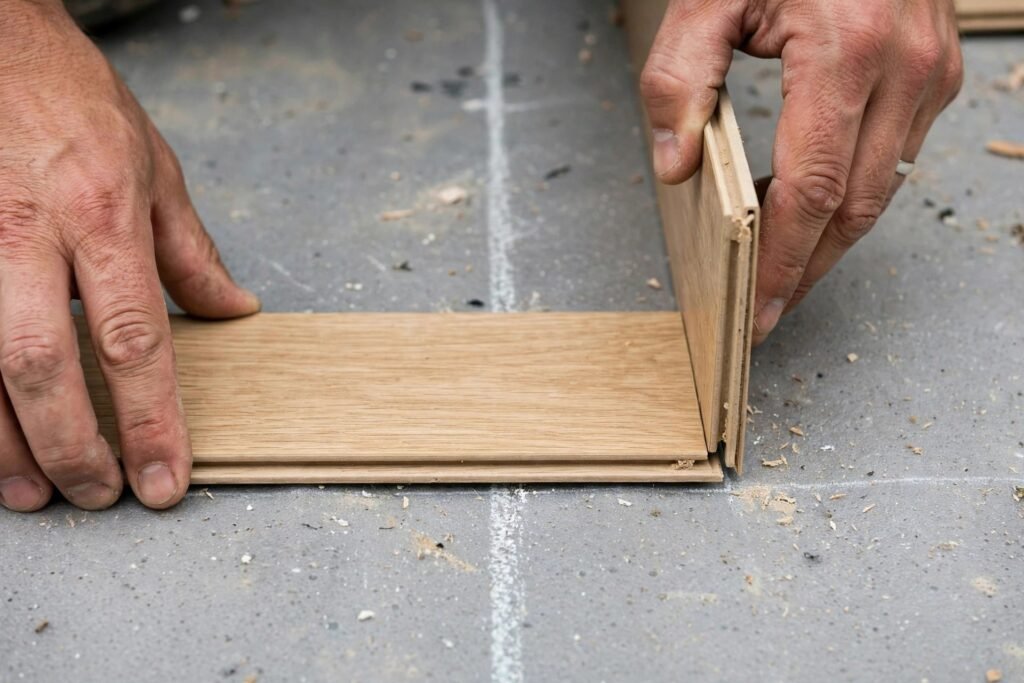
It is the hardest common laminate layout. A confident DIY installer can fit a single rectangular room, especially with a Unizip-type system: mark the centre line, dry-lay the first V square, build outwards in pairs, check alignment every few rows, cut borders last. If the first V is off, the error grows every row.
Hire a fitter for a large, L-shaped or multi-room layout, a subfloor needing levelling, many pipes or angled walls, or an unfamiliar A/B system. Tapi’s UK prices show why labour differs: as of October 2026, £28.50 per m² for herringbone against £15 per m² for straight laminate.
How Much Does Herringbone Laminate Flooring Cost?
No official national price exists; the figures below are attributed retailer/guide ranges for budgeting.
United Kingdom, as of October 2026. Tapi lists herringbone laminate at an average of £32.99 per m² for material, with fitting at £28.50 per m² — about £61.50 per m² combined, before underlay, trims and subfloor work. Flooring Surgeons’ UK cost guide puts material at £18.99–£27.99 per m² and fully installed cost at £45–£70 per m². Both agree: material need not be expensive, but herringbone fitting roughly doubles straight-laminate labour.
United States, as of October 2026. Modernize’s 2026 guide puts mid-range laminate at $3–$5 per sq ft material and $5–$10 installed, water-resistant ranges at $3–$7 material and $5–$12 installed, and herringbone at an extra $1–$3 per sq ft in labour. Add underlay, trims and levelling to either figure.
Herringbone Laminate vs Straight Laminate vs Engineered Wood: Which Should You Choose?
| Herringbone laminate | Straight laminate | Engineered wood herringbone | |
|---|---|---|---|
| Look | Broken zigzag, parquet effect | Long planks, calmer | Same zigzag, real wood surface |
| Surface | Printed décor under a wear layer | Printed décor under a wear layer | Real wood veneer |
| Can it be refinished? | No — replace the block | No — replace the plank | Yes, limited times, by veneer thickness |
| Fitting | Slowest laminate option; centre-out | Fastest, most DIY-friendly laminate | Slowest, most skilled; often glued |
| Waste allowance | 15–20% | About 10% | Similar pattern waste to herringbone laminate |
| Installed cost guide, UK, Oct 2026 | £45–£70 per m² (Flooring Surgeons) | Lower, mainly because fitting is about half the herringbone rate (Tapi) | £80–£140 per m² (Flooring Surgeons) |
| Best for | Parquet character without a wood budget | Value, speed and large areas | Buyers who want real wood and a longer, refinishable life |
In short: against straight laminate, herringbone wins on character and loses on cost, waste and time — the technology is identical. Against engineered wood, laminate wins on cost and cleaning; engineered wood wins on authenticity and longevity, and can be sanded back where worn laminate is replaced.
How Do You Clean and Care for It?
Keep water low and grit off, following manufacturer care guidance for laminate:
- Sweep or vacuum with a soft brush / hard-floor setting — grit dulls the wear layer fastest.
- Damp-mop only, well-wrung, with a pH-neutral laminate cleaner if needed. Wipe spills promptly, especially at joints.
- No steam mop: Pergo, Mohawk and Tarkett all advise against steam on laminate — heat and pressurised moisture can enter joints, swell the core and void the warranty.
- No wax, polish, oil soap or abrasive pads — they film or cut the wear layer; there is no wood to nourish.
- Felt pads under legs, a mat at external doors, and lift — do not drag — heavy furniture.
Keep spares from the original batch: replacing a mid-room block usually means lifting the floor back to that point.
Frequently Asked Questions
Is herringbone laminate flooring waterproof?
Only specific ranges, on their manufacturer’s terms. Quick-Step markets its herringbone as 100% watertight, with a 15-year waterproof surface warranty if installed correctly. Most others are water-resistant only — splashes and damp mopping, not flooding.
Is herringbone more expensive than straight laminate?
Yes, mainly in fitting. Tapi lists £28.50 per m² for herringbone fitting vs £15 per m² straight, as of October 2026, and waste is 15–20% extra instead of about 10%.
Can I lay herringbone laminate myself?
Yes, if you have laid click laminate before, the room is a simple rectangle, and the subfloor is flat within tolerance — for Quick-Step, no more than 2 mm over 1 metre. For large, awkward or multi-room work, hire a fitter.
What is the difference between herringbone and chevron laminate?
Herringbone: square-ended blocks at 90 degrees, a broken zigzag. Chevron: angle-cut blocks (usually 45° or 60°) meeting point-to-point in a continuous V. Different products; they cannot be interchanged by trimming.
Should I choose AC3 or AC4 herringbone laminate?
AC4 for halls, kitchens and busy rooms — at least 4,000 abrasion cycles under EN 13329, and the rating most herringbone ranges carry. AC3 suffices for bedrooms. AC measures abrasion only, not water resistance.
How much herringbone laminate should I order?
Add 15% for a simple rectangle, up to 20% for a small or awkward room — Topps Tiles’ guidance is an extra 15–20% for herringbone waste. Order in one batch; keep spares.
Can herringbone laminate go in a kitchen or bathroom?
Kitchen: yes for water-resistant or warranted-waterproof ranges, if spills are wiped promptly and sealing instructions are followed. Bathroom: only a range whose warranty explicitly covers bathrooms, sealed exactly as instructed. Standard laminate belongs in dry rooms only.
Sources: Quick-Step guidance and data sheet; NALFA LF-01; Floor Covering Reference Manual (EN 13329); Topps Tiles; pricing — Tapi, Flooring Surgeons, Modernize (Oct 2026).