









On the night of 6–7 July 2025, United Airlines flight UA82 from Newark to Delhi declared an emergency about an hour after takeoff and turned back, after an automated fault message flagged a problem in the aircraft’s electronics cooling system, according to Simple Flying’s report based on flight-tracking data. The Boeing 787-9 landed safely back at Newark at 11:15 p.m. local time, and no passengers or crew were injured. It remains, as of October 2026, the incident behind almost every “UA82 emergency” search — and it is often confused online with two unrelated United returns that involved different flights.
At a Glance
- Flight: United Airlines UA82 (callsign UAL82), a scheduled passenger service
- Route: Newark Liberty International Airport (EWR), New Jersey → Indira Gandhi International Airport (DEL), Delhi, India
- Frequency and aircraft: Daily, normally operated by a Boeing 787-9 Dreamliner; scheduled departure about 9:15 p.m. from Newark, arriving Delhi about 9:30 p.m. the next day (a block time of roughly 14 hours 45 minutes)
- The incident: Night of 6–7 July 2025
- Aircraft involved: Boeing 787-9, registration N23983 (delivered to United in September 2020)
- What happened: An automated maintenance message reported a fault in the electronics (EE) cooling system, System 1; the crew declared an emergency, reversed course over the Gulf of Maine and returned to Newark
- Where it landed: Back at Newark (EWR) at 11:15 p.m. local time; passengers left the aircraft at Terminal C
- Outcome: No injuries; the flight was cancelled, the aircraft was taken out of service for inspection, and passengers were rebooked
- Earlier UA82 diversion: 4 March 2018 — a medical diversion to London Heathrow (that flight was operated by a Boeing 777)
- Account based on: Simple Flying’s incident report, the aircraft’s ACARS fault message reproduced by Aviation A2Z, and, for 2018, The Times of India quoting United’s statement
What Is United Airlines Flight UA82?
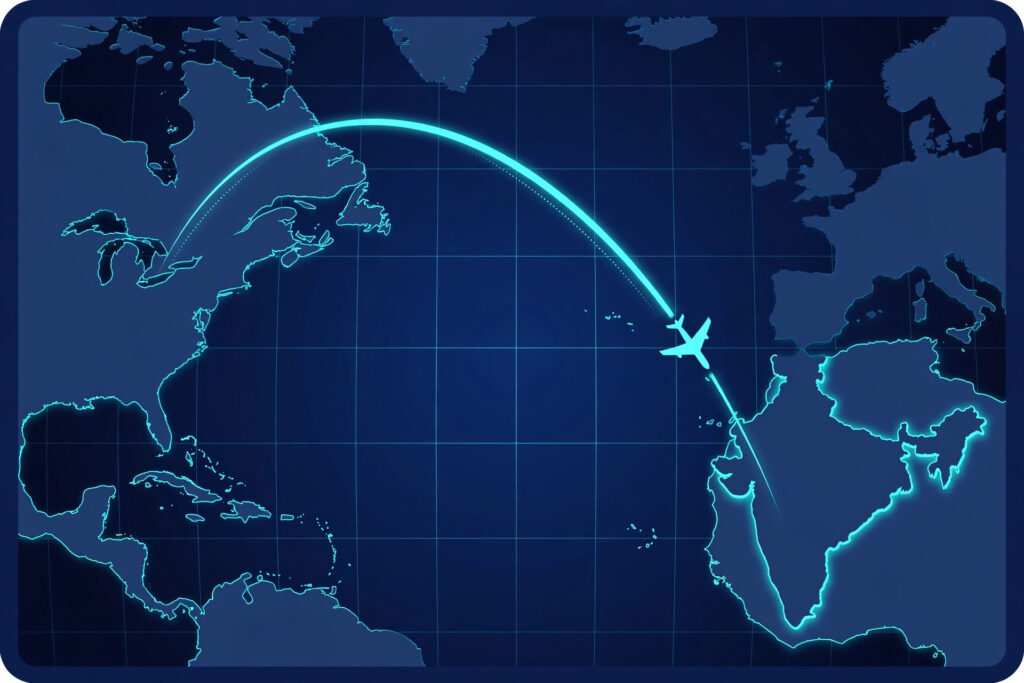
UA82 is United Airlines’ daily nonstop from Newark Liberty International Airport to Delhi’s Indira Gandhi International Airport — one of the longest routes in United’s network, at roughly 7,300 miles (about 11,750 km). As of October 2026 the flight is scheduled to leave Newark at about 9:15 p.m. and reach Delhi at about 9:30 p.m. the following day, local times, with the return leg from Delhi to Newark numbered UA83. United schedules the Boeing 787-9 Dreamliner on the route.
That has not always been the equipment. When UA82 diverted to London in 2018 (see below), the flight was operated by a Boeing 777 — so older reports describing UA82 as a 777 service are describing the route as it was then flown, not as it is flown today.
What Happened on UA82 on the Night of 6–7 July 2025?
The flight departed Newark as normal
UA82 departed Newark on the evening of Sunday 6 July 2025, at about 9:21–9:30 p.m. local time (published tracking summaries differ by a few minutes). The aircraft was the Boeing 787-9 registered N23983, a Dreamliner delivered to United in September 2020 and powered by two GEnx engines. The flight climbed to its cruising level of 33,000 feet (FL330) and headed north-east on the first part of the long overwater routing toward India.
An automated fault message flagged the cooling system
Roughly 45 minutes to an hour into the flight, the aircraft’s systems generated an automated maintenance message — an ACARS message sent automatically from the aircraft to United’s ground maintenance teams. The message, timestamped 01:46 UTC on 7 July and reproduced by Aviation A2Z, carried the text “EE COOLING OPS (1)” with fault reporting code FRC 202, indicating a fault in the electronics equipment cooling system, System 1.
Simple Flying, reporting from Flightradar24 tracking data, describes the same event the same way: the return “was prompted by an automated maintenance message indicating a fault in the aircraft’s electronics cooling system (System 1).”
The crew declared an emergency and turned back over the Gulf of Maine
After the fault appeared, the pilots declared an emergency and reversed course over the Gulf of Maine, according to Simple Flying. Flight-tracking-based reports of the incident state that the aircraft squawked 7700, the transponder code that tells air traffic control an aircraft has declared an emergency and needs priority handling.
There was no descent drama and no diversion to a nearer airport: the aircraft was still relatively close to its departure point, so the crew flew a controlled return to Newark, the airline’s hub, where its own maintenance organisation is based.
A safe landing back at Newark
UA82 landed safely back at Newark at 11:15 p.m. local time — under two hours after it had left. Passengers and crew left the aircraft normally at Terminal C. No injuries were reported. The flight to Delhi was cancelled, the Dreamliner was taken out of service for inspection, and passengers were rebooked onto later services; travel-trade reporting of the incident described meal vouchers and hotel accommodation being provided to those stranded overnight.
The aircraft itself was not grounded for long. Tracking data reported by Simple Flying showed N23983 back in service within weeks — operating a domestic Newark–Houston leg with an onward Tokyo Narita service planned, and on 3 August 2025 flying United’s Newark–Cape Town route (as a different flight number, UA1122 — an important distinction explained below).
Why Did the Crew Turn Back? What Is “EE Cooling”?
The “EE” in the fault message stands for the aircraft’s electrical/electronics equipment bay — the compartment housing the computers that run the jet’s navigation, communications and flight systems. Those avionics generate heat and depend on a dedicated cooling system to stay within safe operating temperatures. Simple Flying notes that this type of issue, “particularly when related to EE bay cooling, is considered critical due to its role in protecting the aircraft’s avionics,” and that depending on severity and redundancy it “can lead to operational limitations or require diversion.”
Context matters here. UA82 was not on a one-hour hop: it was at the start of a roughly 14-hour overwater flight, most of it far from a suitable runway. Crews treat cooling faults conservatively on long-haul sectors because a problem that is manageable near home can become a much bigger one mid-ocean if it worsens or if the redundant system is also affected. Turning back while still close to Newark — with the airline’s own engineers, a replacement aircraft and rebooking desks all on hand — is the low-risk option, and it is the option the crew took. It is the same principle that governs a lot of long-distance travel technology: systems you never think about, from avionics cooling on a Dreamliner to battery and range management in an electric car (the subject of our Cadillac Lyriq driving modes and range explainer), decide how far you can safely go.
What no reputable report does is identify why the cooling system faulted. As of October 2026, neither United nor the FAA has published a root-cause finding for the 6–7 July 2025 event in the public record, so any article that tells you exactly which component failed and why is going beyond the evidence.
Were Any Passengers Hurt on UA82?
No. Every reputable account of the July 2025 return agrees on the outcome: the aircraft landed normally, everyone on board left the aircraft at the gate at Terminal C, and there were no injuries to passengers or crew. Despite the word “emergency” — which in aviation simply means the crew has declared a priority situation to air traffic control — this was a precautionary return and a normal landing, not an emergency evacuation. Claims circulating on some flight-emergency content sites that passengers “evacuated” the aircraft, or precise on-board headcounts for that night, are not supported by the reputable reporting; United did not publish a passenger number for the flight.
What Did United Airlines Say?
United did not issue a detailed public statement about the July 2025 return that major outlets carried — unusually for a viral flight story, the public record of what happened comes mainly from flight-tracking data and the aircraft’s own ACARS maintenance message, as reported by Simple Flying and Aviation A2Z. What is established is the airline’s standard response pattern: the flight was cancelled, the aircraft was withdrawn for inspection, and customers were rebooked, with vouchers and hotels reported. Anyone quoting a lengthy United statement about the cooling fault itself is quoting something that does not appear in the reputable coverage.
United did comment on the record about the same airframe a month later, when N23983 was flying a different route — see the timeline below — confirming to Simple Flying that a spoiler indication message had prompted that return as a precaution and that inspections found no visual problem. That statement concerns the August flight, not UA82, and the two should not be merged.
Has UA82 Had Other Emergencies? A Dated Timeline
UA82 is a daily flight, so it has operated thousands of times; reputable records document two emergency or diversion events under this flight number, seven years apart — plus two 2025 incidents that are frequently mislabelled as UA82 online.
4 March 2018 — medical diversion to London Heathrow
On Sunday 4 March 2018, UA82 from Newark to Delhi — then operated by a Boeing 777 with 266 passengers and 15 crew — diverted to London Heathrow after a passenger was taken unwell, according to The Times of India. The aircraft had crossed Greenland when the crew decided to land at Heathrow so the passenger could get treatment. United said in a statement at the time: “Our team at London Heathrow Airport is providing assistance to customers of United flight 82 (New York/Newark to Delhi) which was diverted to London Heathrow Airport because of a medical issue onboard.” The flight was then cancelled because the crew had reached their maximum permitted duty time; United provided hotel accommodation and arranged for customers to complete their journeys the following day, and apologised for the inconvenience.
6–7 July 2025 — emergency return to Newark (the incident described above)
The Boeing 787-9 operating UA82 declared an emergency after the electronics cooling fault message and landed back at Newark at 11:15 p.m., with no injuries.
Two incidents that were NOT UA82 — a common mix-up
Because the same airframe later had two more returns, several round-up articles and videos wrongly file them under UA82. For the record:
- 3 August 2025: N23983 — the same aircraft as the July UA82 flight — returned to Newark with a spoiler indication while operating UA1122 to Cape Town, not UA82. United confirmed to Simple Flying that a spoiler indication message had illuminated, the crew returned as a precaution, and maintenance found no visual issue with the spoilers.
- 20 August 2025: a different Boeing 787-9 (N27965), also operating UA1122 to Cape Town, returned to Newark 55 minutes after departure after a smoke indication in a cabin compartment; it landed on runway 04R after dumping fuel, was inspected by emergency crews, and no fire was found.
Same airline, same airport, in one case the same aircraft — but different flight numbers and different events. Details from those August returns (spoilers, smoke, fuel dumping) do not belong to the UA82 story.
Frequently Asked Questions
What happened on United Airlines flight UA82?
On the night of 6–7 July 2025, UA82 from Newark to Delhi declared an emergency after an automated fault message flagged a problem in the Boeing 787-9’s electronics (EE) cooling system, System 1. The crew turned back over the Gulf of Maine and landed safely at Newark at 11:15 p.m. local time. No one was injured, according to Simple Flying’s report based on flight-tracking data and the aircraft’s ACARS message reproduced by Aviation A2Z.
When did the UA82 emergency happen?
The flight departed Newark on the evening of Sunday 6 July 2025 (about 9:21–9:30 p.m. local time). The cooling fault message was timestamped 01:46 UTC on 7 July, and the aircraft landed back at Newark at 11:15 p.m. local time — which is why most coverage dates the incident 7 July 2025.
What route does UA82 fly, and on what aircraft?
UA82 is United Airlines’ daily nonstop from Newark Liberty International Airport (EWR) to Delhi’s Indira Gandhi International Airport (DEL), a journey of roughly 7,300 miles with a scheduled time of about 14 hours 45 minutes. As of October 2026 it is operated by a Boeing 787-9 Dreamliner; the return flight is UA83. In 2018 the route was flown by a Boeing 777.
Why did UA82 turn back to Newark?
Because of a fault in the electronics cooling system — the system that keeps the aircraft’s avionics computers at safe temperatures. As Simple Flying explains, EE bay cooling faults are treated as critical because they protect the avionics, and at the start of a 14-hour overwater flight the conservative, checklist-driven decision is to return while still close to base rather than continue toward Delhi.
Did UA82 squawk 7700?
Flight-tracking-based reports of the incident state that the crew declared an emergency and squawked 7700, the universal transponder code for a declared emergency. Simple Flying confirms the crew “declared an emergency” after the cooling fault message appeared; the aircraft then received priority handling for its return to Newark.
Was anyone injured on UA82?
No. All reputable reports agree that the 6–7 July 2025 return ended with a normal landing at Newark, passengers leaving the aircraft at Terminal C, and no injuries to passengers or crew. It was a precautionary return, not an evacuation.
Has UA82 ever diverted anywhere else?
Yes — once before in the reputable record. On 4 March 2018, UA82 (then a Boeing 777) diverted to London Heathrow after a passenger fell ill; United said the flight was then cancelled because the crew reached their maximum duty time, and passengers were given hotels and onward travel the next day (The Times of India, quoting United’s statement). Two other United returns in August 2025 — a spoiler indication on 3 August and a smoke indication on 20 August — involved flight UA1122 to Cape Town, not UA82, despite often being reported as if they were the same story.
Sources: Simple Flying (report on the July 2025 UA82 emergency return and the 3 August 2025 UA1122 spoiler return, including United’s confirmation; longest-routes schedule data); Aviation A2Z (UA82 emergency landing report, 7 July 2025, reproducing the aircraft’s ACARS “EE COOLING OPS (1) FRC 202” message and Flightradar24 data; report on the 20 August 2025 UA1122 return); The Times of India via Aviation India (4 March 2018 London Heathrow medical diversion, including United Airlines’ statement). Facts checked October 2026.