








Looking back from 2026, the latest breakthroughs in quantum computing 2024 marked the year the field finally crossed its most important threshold: quantum error correction started working the way theorists had promised since 1995. Google’s Willow chip, announced on December 9, 2024, demonstrated the first “below threshold” error correction, while Microsoft and Quantinuum built logical qubits that decisively outperformed raw physical qubits, and IBM pivoted from chasing qubit counts to chasing qubit quality. Together with NIST’s publication of the first post-quantum cryptography standards in August 2024, these milestones turned quantum computing from a research promise into an engineering discipline with a credible roadmap.
To understand why the latest breakthroughs in quantum computing 2024 mattered so much, it helps to know the basic problem they solved. Quantum bits, or qubits, are extraordinarily fragile: the slightest vibration, temperature change, or stray electromagnetic noise can corrupt their calculations. For three decades, the standard answer was to combine many unreliable physical qubits into one reliable “logical qubit” — but until 2024, adding more physical qubits usually made errors worse, not better. What changed in 2024 is that multiple teams, on multiple hardware platforms, finally showed error rates falling as systems grew larger. This retrospective walks through each verified milestone of that pivotal year, explains what logical qubits actually are in plain language, and separates the genuine breakthroughs from the hype — including an honest answer about whether quantum computers can now break your encryption.
What Were the Biggest Quantum Breakthroughs of 2024?
The defining story of the year was error correction — the unglamorous, essential plumbing of quantum computing. Four distinct hardware teams delivered proof that logical qubits could now outperform the physical qubits they were built from: Google with its 105-qubit Willow processor in December, Microsoft and Quantinuum with trapped-ion logical qubits in April and again in September, Microsoft with Atom Computing on neutral atoms in November, and IBM with its quality-first Heron r2 processor. Each result attacked the same fundamental problem — quantum noise — from a different engineering direction, and each succeeded where decades of earlier attempts had stalled.
The second big story of 2024 was cryptography. On August 13, 2024, the U.S. National Institute of Standards and Technology published its first three post-quantum cryptography standards — ML-KEM, ML-DSA, and SLH-DSA — giving governments and companies a concrete migration target against future quantum attacks. This was the year’s true security milestone, and it matters more than any benchmark result: it turned “quantum computers might one day break encryption” into a dated migration deadline. The rest of this guide examines each breakthrough in detail, with dates, numbers, and named sources, so you can see exactly what 2024 delivered — and what it did not.
Google’s Willow Chip: Below-Threshold Error Correction
Among the latest breakthroughs in quantum computing 2024, Google’s Willow announcement on December 9, 2024, drew the most attention — and for good reason. Willow is a 105-qubit superconducting processor built at Google’s Santa Barbara fabrication facility, with qubit coherence of roughly 100 microseconds, about five times better than its Sycamore predecessor. Its headline achievement was the first-ever demonstration of “below threshold” quantum error correction: as the team grew its surface-code grids from 3×3 to 7×7 physical qubits, the logical error rate roughly halved each time — and a distance-7 logical qubit ended up outliving every one of its 101 constituent physical qubits, crossing the break-even point error-correction researchers had chased since 1995.
Willow’s second headline number was its random circuit sampling benchmark: the chip completed the calculation in under five minutes, a task Google estimated would take a leading classical supercomputer around 10^25 years — ten septillion years. But honesty matters here, and Google itself was clear about the caveat: random circuit sampling has no known practical use. It is a deliberately hard benchmark, not a useful computation, and Willow poses no threat to RSA-2048 or any encryption you actually rely on. The genuine story of Willow is the error-correction result, not the benchmark — a distinction worth keeping straight whenever 2024’s quantum headlines get retold.
Microsoft and Quantinuum: 4 Logical Qubits in April
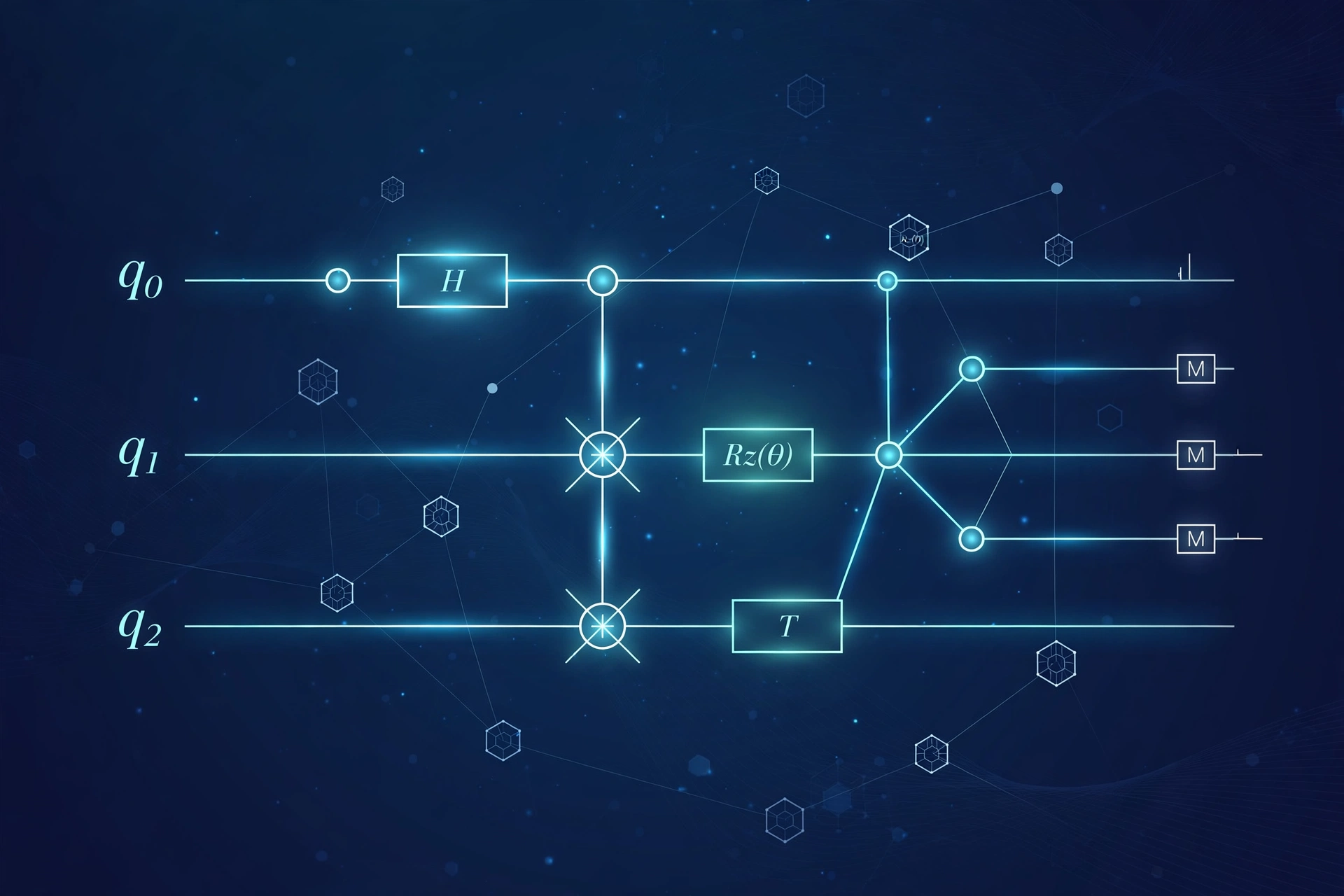
Among the latest breakthroughs in quantum computing 2024, the April 3, 2024 announcement from Microsoft and Quantinuum may have been the most scientifically significant of all. Working on Quantinuum’s H2 trapped-ion machine, the two companies created four logical qubits from thirty physical qubits — and those logical qubits showed an error rate 800 times better than the raw physical qubits beneath them. Across more than 14,000 circuit runs, the system recorded zero uncorrected errors. Microsoft called the achievement “Level 2 Resilient” quantum computing, and it represented the first time error-corrected qubits had decisively beaten uncorrected ones.
Why did this matter so much? Because trapped-ion hardware works on completely different physics from Google’s superconducting chips, yet it produced the same verdict: logical qubits now win. To put the concept in plain terms, a logical qubit is like a committee of noisy physical qubits that vote together to cancel out each other’s mistakes — and in April 2024, the committee finally started outperforming its individual members. The result was reported by industry analysts at the time, and it set the stage for an even more ambitious demonstration five months later.
The 12-Logical-Qubit Follow-Up in September
On September 10, 2024, Microsoft and Quantinuum returned with a bigger number and a harder test: twelve logical qubits running on Quantinuum’s H2 system, built from 56 physical qubits with 99.8% two-qubit gate fidelity. This time the demonstration combined fault-tolerant computation with multiple rounds of error correction in a single experiment, achieving a 22-times-better circuit error rate in a GHZ entangled state. The team even ran a hybrid end-to-end chemistry simulation, showing error-corrected quantum hardware beginning to touch real scientific workloads rather than abstract benchmarks.
The September result is worth pausing on because it answered the obvious skeptic’s question about April: was four logical qubits a fluke of a tiny system? Twelve logical qubits, entangled and error-corrected across repeated correction rounds, said no. The experiment details were published on the Microsoft Azure quantum blog, which remains one of the clearest public records of the year’s progress. Taken together, the April and September demonstrations showed trapped-ion logical qubits scaling gracefully — exactly the behavior a future fault-tolerant quantum computer would need.
Microsoft and Atom Computing: 24 Logical Qubits on Neutral Atoms
November 2024 brought the year’s third hardware architecture into the logical-qubit race. Microsoft, this time partnering with Atom Computing, entangled 24 logical qubits on a neutral-atom platform built from 112 physical atoms — the largest entangled set of logical qubits reported anywhere in 2024. Neutral atoms trap individual atoms in grids of laser light, a completely different approach from both superconducting circuits and trapped ions. That three unrelated technologies all demonstrated working error-corrected coherence at scale in the same calendar year is one of the strongest signals that 2024’s progress was fundamental rather than lucky.
The neutral-atom result also mattered for a practical reason: neutral-atom systems are considered among the most promising paths to very large qubit counts, since adding more atoms is relatively straightforward compared with wiring up more superconducting circuits. Demonstrating error correction on this platform in 2024 meant the scaling story no longer depended on a single horse. For readers keeping score at home, the year’s logical-qubit tally read like a ladder — four in April, twelve in September, twenty-four entangled in November — each step on a different machine, each one working.
IBM’s Quality Pivot: Heron r2
IBM took a different lesson from the decade’s qubit-count race. After unveiling the 1,121-qubit Condor processor in 2023 — a scale demonstration — the company pivoted in 2024 to quality over quantity with Heron r2, a 156-qubit processor featuring TLS mitigation for better coherence and the ability to run around 5,000 two-qubit gates. Heron r2 became the workhorse behind IBM’s Quantum System Two deployments. The message was unmistakable: in the error-correction era that 2024 inaugurated, a smaller number of better qubits beats a larger number of noisier ones.
This pivot deserves emphasis because it reframed how the whole industry talks about progress. For years, press releases competed on raw qubit counts, a metric that said little about whether those qubits could do anything useful. Heron r2’s 2024 arrival — alongside the logical-qubit results from Google, Microsoft, Quantinuum, and Atom Computing — helped cement a new scoreboard: gate fidelity, coherence time, and logical error rates. If you remember one thing about IBM in 2024, remember this: the company stopped asking “how many qubits?” and started asking “how good are they?”
NIST’s Post-Quantum Cryptography Standards
Rounding out the latest breakthroughs in quantum computing 2024, the year’s most consequential security event had nothing to do with a quantum processor at all. On August 13, 2024, the U.S. National Institute of Standards and Technology published its first three post-quantum cryptography standards — ML-KEM, ML-DSA, and SLH-DSA — after a multi-year global competition to find encryption algorithms that can withstand quantum attacks. These standards give banks, governments, hospitals, and technology companies a concrete, dated migration target: the cryptographic foundations of the internet now have an official upgrade path.
Why does this belong in a breakthroughs list? Because it is the one 2024 milestone that changes what organizations must actually do. Willow’s benchmark will not decrypt your messages; the NIST standards will re-encrypt them. Security teams worldwide began planning migrations in late 2024, and the standards turned a vague future threat — “quantum computers might one day break encryption” — into a project with a timeline. When historians look back at 2024, the hardware results will read as the science, and the NIST publication as the policy.
What 2024 Actually Changed (and What It Didn’t)
So what did 2024 actually change? Three things, stated plainly. First, error correction became real engineering: logical qubits beating physical qubits, demonstrated by four teams on three hardware platforms, ended the era when quantum progress was measured in press-release qubit counts. Second, the industry’s scoreboard changed with it — gate fidelity, coherence, and logical error rates replaced raw scale as the metrics that matter. Third, cryptography got its migration deadline, turning quantum risk from speculation into a dated project plan. These are durable, structural shifts, not one-off stunts.
And what didn’t change? Just as much. No 2024 machine ran a useful computation that a classical computer couldn’t — random circuit sampling remains a benchmark, not an application. No 2024 result threatens RSA-2048 or the encryption protecting your bank account; anyone claiming otherwise is selling something. And the timeline to a cryptographically relevant quantum computer is still measured in years, not months. The honest summary is this: 2024 didn’t deliver quantum advantage, but it delivered something arguably more important — proof that the road to it is real. That proof is why 2024 deserves its reputation as the year error correction won.
Conclusion
The latest breakthroughs in quantum computing 2024 shared a single theme: the field grew up. Google’s Willow proved error rates could fall as systems grew; Microsoft, Quantinuum, and Atom Computing showed it on three different physics platforms; IBM bet its roadmap on qubit quality; and NIST gave the world its post-quantum cryptography migration plan. None of these milestones made headlines the way a “quantum supremacy” claim does, but together they did something more valuable — they replaced hope with evidence. For a technology that had spent a decade promising the future, 2024 was the year it started delivering the present.
If 2024 taught the quantum world anything, it is that the technologies that change our lives arrive quietly, one engineering milestone at a time — much like the electric-vehicle revolution, whose journey from lab curiosity to showroom staple we traced in our Tesla Model Y explainer. Keep this guide bookmarked as a reference for what 2024 actually achieved, and judge future quantum headlines against its standard: real error correction, real numbers, real dates — and honest caveats where the hype outruns the hardware.
What was Google’s Willow chip breakthrough in December 2024?
Google announced its Willow quantum chip on December 9, 2024: a 105-qubit superconducting processor built at Google’s Santa Barbara facility. Its landmark result was the first “below threshold” quantum error correction ever demonstrated — as surface-code grids grew from 3×3 to 7×7 physical qubits, logical error rates roughly halved each time, and a distance-7 logical qubit outlived all 101 of its constituent physical qubits. Willow also ran a random-circuit-sampling benchmark in under five minutes, which Google estimated would take a classical supercomputer about 10^25 years — though Google itself noted this benchmark has no known practical use.
What are logical qubits, and why did they matter in 2024?
A logical qubit is a single reliable quantum bit assembled from many noisy physical qubits that work together to detect and cancel out each other’s errors — like a committee voting to correct its members’ mistakes. They mattered in 2024 because, for the first time, logical qubits decisively outperformed the physical qubits they were built from: Microsoft and Quantinuum’s April 2024 demonstration showed logical error rates 800 times better than physical ones across 14,000+ circuit runs with zero uncorrected errors, and Google’s Willow showed error rates falling as systems grew. That crossing — from theory to working engineering — is why 2024 is remembered as the year error correction won.
Did any 2024 quantum breakthrough break encryption like RSA-2048?
No. None of the 2024 quantum computing milestones — not Google’s Willow, not the Microsoft–Quantinuum logical-qubit demonstrations, not IBM’s Heron r2 — came anywhere near threatening RSA-2048 or the encryption protecting everyday online activity. Breaking RSA-2048 would require millions of stable physical qubits running deep error-corrected circuits; 2024’s machines operated at the scale of dozens to hundreds of qubits. The year’s genuine security milestone was different: on August 13, 2024, NIST published its first three post-quantum cryptography standards (ML-KEM, ML-DSA, SLH-DSA), starting the real-world migration to quantum-resistant encryption.
What did NIST announce about post-quantum cryptography in 2024?
On August 13, 2024, the U.S. National Institute of Standards and Technology (NIST) published the first three finalized post-quantum cryptography standards: ML-KEM, ML-DSA, and SLH-DSA. These are encryption algorithms designed to resist attacks from future quantum computers, selected through a years-long global competition. Their publication gave governments, banks, hospitals, and technology companies a concrete, official migration target — turning “quantum computers might one day break encryption” from a vague future worry into a dated project plan that security teams began acting on in late 2024.
Which companies led quantum computing breakthroughs in 2024?
Five names defined the year. Google made the biggest splash with Willow in December 2024, delivering the first below-threshold error correction. Microsoft partnered twice — with Quantinuum on trapped-ion logical qubits in April (4 logical qubits) and September (12 logical qubits), and with Atom Computing on neutral atoms in November (24 entangled logical qubits). Quantinuum’s H2 trapped-ion machine, with 99.8% two-qubit gate fidelity, was the hardware behind both Microsoft collaborations. IBM contributed Heron r2, a 156-qubit processor marking the industry’s pivot from qubit quantity to qubit quality. And NIST, while not a company, set the year’s security agenda with its post-quantum standards.
Why is 2024 considered the year quantum error correction won?
Of all the latest breakthroughs in quantum computing 2024, the error-correction results are the ones historians will cite because they changed the field’s direction. Before 2024, adding more physical qubits typically made errors worse; during 2024, four independent teams — Google, Microsoft with Quantinuum (twice), Microsoft with Atom Computing, and IBM — showed error rates falling as systems grew, across three different hardware architectures. That convergence, from superconducting circuits to trapped ions to neutral atoms, proved the progress was fundamental rather than a one-team fluke. Error correction went from a 30-year-old theory to working engineering in a single calendar year.