









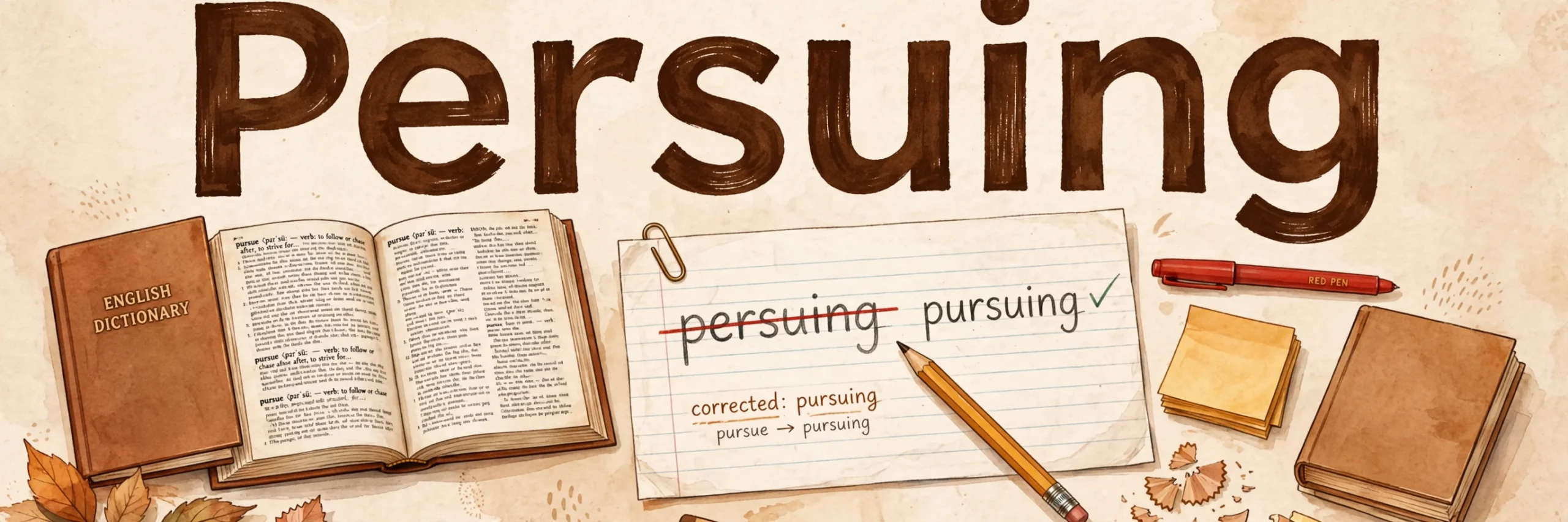
You have probably seen the word persuing in a message, an essay, or a social media post, and wondered whether it is correct. The short answer is that persuing is not correct in modern standard English, and the word most writers mean is pursuing. If you enjoy clear explanations of words that are often confused, you will also like Lyposingrass: Real Plant Or Just An Online Wellness Trend?.
Is Persuing A Real Word?
The simplest answer is no. In modern standard English, persuing has no meaning of its own, and it is not listed in Merriam-Webster, Oxford, Cambridge, or Collins. Recognition is not the same as correctness, and one small error can distract from a strong message in school or at work.
What The Dictionaries Say
Dictionaries record the words used in accepted standard English. The correct word, pursue, is listed with its forms pursued and pursuing, and with the nouns pursuit and pursuer. The incorrect form has no entry, because there is nothing separate for it to define. It is simply the correct word written with the wrong second syllable, and persuing should not be treated as a word in its own right.
Persuing Or Pursuing: What Is The Difference?
The difference is one letter. The correct spelling is pursuing, spelled P-U-R-S-U-I-N-G, and the incorrect spelling is persuing, spelled P-E-R-S-U-I-N-G. The correct form begins with “pur-“, while the incorrect form begins with “per-“.
This is not a regional variant, an informal spelling, or an old form that is still acceptable today. In modern standard English, only the “pur-” form is correct. Some sources mention an obsolete form, but that claim is not settled.
Correct And Incorrect Forms Side By Side
| Spelling | Status | Root Word | Dictionary Listed? | Use It? |
|---|---|---|---|---|
| Pursuing | Correct | pursue | Yes | Always |
| Persuing | Incorrect | none — error of “pursue” | No | Never |
| Persue | Incorrect | none | No | Never |
| Pursued | Correct | pursue | Yes | Always |
The table makes the choice simple. Two forms are correct, two are not, and the correct forms both come from pursue.
The examples below show the same idea in four common settings. Read the correct sentence first, then the incorrect version.
| Setting | Correct Sentence | Incorrect Sentence |
|---|---|---|
| Career | She is pursuing her career goals. | She is persuing her career goals. |
| Education | He is pursuing a degree in engineering. | He is persuing a degree in engineering. |
| Law | The police are pursuing the suspect. | The police are persuing the suspect. |
| Everyday | They are pursuing a healthier lifestyle. | They are persuing a healthier lifestyle. |
In each pair, the meaning is clear either way, which is why the error survives. Only the correct sentence would pass a spelling check in edited writing.
What Does Pursuing Mean?
The meaning here belongs to pursue and pursuing only, as recorded by Merriam-Webster. Pursue is a verb meaning to follow in order to overtake, catch, kill, or defeat; to seek or obtain something; to proceed along a course; to engage in an activity; and to follow up a matter. It is pronounced /pərˈsuː/, spoken as “per-SOO”.
The word comes from Middle English, from the Anglo-French words pursure and pursiure, and from the Latin prosequi, formed from pro-, meaning forward, and sequi, meaning to follow. Its first known use in English dates to the 14th century.
Pursuing A Goal Or Career
The most common modern use is seeking a goal. You can pursue a career, a degree, a dream, a business idea, or a promotion. In each case, the word suggests steady effort over time, not a single action.
Why Do People Write Persuing?
People write the incorrect form for understandable reasons. The first reason is sound: the word is pronounced “per-SOO”, so the ear hears “per-” at the start, and the hand writes what the ear hears. English spelling is full of words that are not spelled as they sound, and persuing is one of the clearest examples.
It Sounds Like “Per-Soo”
If you say the word aloud, the first syllable sounds like “per”, not “pur”. Many English learners, and many native speakers, trust their ears when they are unsure of a spelling, and here the ear gives the wrong answer. Learn the spelling as a visual pattern: once you know the word begins with “pur”, you can avoid writing persuing by writing pursuing instead.
How To Spell Pursuing Correctly Every Time
The best way to spell the word correctly is to build a small set of memory tricks and use them until they become automatic. Start with the root word, then add the ending, and check the first three letters. If you write persuing, stop and change the second letter to “u”.
Remember “Pur” Like Purpose And Purse
Link the first syllable to two familiar words that share it: purpose and purse. All three begin with “pur”, and all three are spelled with “u” as the second letter.
Count The Two U’s In Pursue
Another trick is to count the letter “u”. The root word pursue contains two letter u’s: one in “pur” and one in “su”. The incorrect form loses the first of those. If you have used only one “u”, you have almost certainly written the wrong form.
Drop The “E” And Add “Ing”
The ending follows a simple rule. Start with pursue, drop the final “e”, and add “ing”. That gives pursuing, with no other change to the word. The same rule gives “pursued” from “pursue” by adding “d”.
Quick Self-Test
Try these three questions, then check your answers. First: “She is ___ her dream of becoming a doctor.” Second: choose the correct spelling for a job letter, pursuing or the “per-” form. Third: “They are chasing their goals and ___ a new business.” The answers are pursuing in all three cases.
Common Mistakes To Avoid
The most common mistake is the one this guide is about, and persuing appears in all kinds of writing. The forms persue, persuing, and persued are also incorrect, as is the invented spelling pershue. Each one should be corrected to pursue, pursuing, or pursued.
Do Not Confuse It With “Perusing”
A second confusion involves a different real word: perusing, meaning to read or examine something carefully. It is spelled with “per-“, so it looks like the incorrect form, but the two words are not related. You peruse a report when you read it closely, and you pursue a goal when you work toward it.
Frequently Asked Questions
Is Persuing A Real Word?
No. It has no meaning in standard English and is not listed in Merriam-Webster, Oxford, Cambridge, or Collins. It is a misspelling of pursuing, and it should not be used in school, at work, or in edited writing.
Is It Persuing Or Pursuing?
The correct spelling is pursuing, spelled P-U-R-S-U-I-N-G, and the incorrect form should never be used. Remember that it begins with “pur-“, as in purpose and purse, and comes from pursue.
What Is The Meaning?
It has no meaning of its own, so any definition you see for it really belongs to pursuing. Pursuing means following in order to overtake or catch, seeking a goal, proceeding along a course, or engaging in an activity.
How Do You Spell Pursuing Correctly?
Start with pursue, drop the final “e”, and add “ing” to get pursuing. Remember “pur” like purpose and purse, and count the two u’s in pursue.
What Is The Difference Between Persuing And Perusing?
The first is an incorrect spelling of pursuing, while perusing is a different real word meaning to read or examine something carefully. Pursuing means seeking a goal, a person, or an outcome, while perusing means reading closely.
How Can I Remember The Spelling Of Pursuing?
Link “pur” to purpose and purse, count the two u’s in pursue, and practise dropping the “e” and adding “ing”. Try the self-test in this guide, then use the word in a few sentences of your own.