








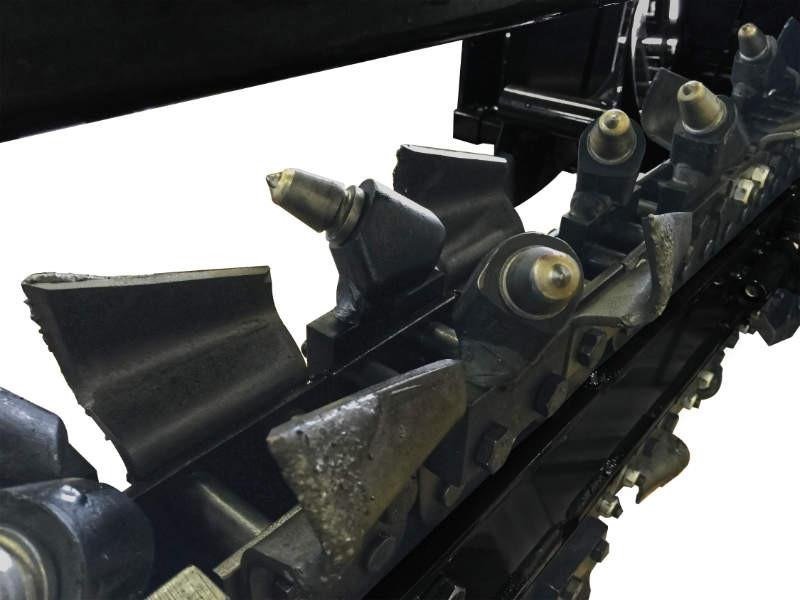
A trencher tooth that cuts effectively in one rock formation may struggle in another. Softer rock may allow the cutting edge to penetrate more easily, while harder or more abrasive formations can increase cutting resistance and wear. The difference is not just the carbide material. The tooth’s cutting profile also affects how it contacts the rock, penetrates the surface, and transfers force during cutting. Matching the profile to the ground conditions is therefore essential.
What Rock Properties Affect Trencher Tooth Performance?
Rock formations differ in more than hardness. Their strength, abrasiveness, and internal structure all affect how trencher teeth engage with the material and how quickly their cutting edges wear.
1. Rock Hardness and Strength
Hard, dense rock generally requires greater cutting force to penetrate. A tooth with a broad, relatively blunt profile may struggle to enter these formations, while a more pointed cutting profile can concentrate force over a smaller contact area. The actual cutting performance still depends on the tooth design and machine capacity.
2. Rock Abrasiveness
Some rock formations contain abrasive minerals, such as quartz, that gradually wear down the carbide cutting surface. This can happen even in rock that is not particularly hard. As the cutting edge becomes rounded or worn, its ability to penetrate the material may decrease.
3. Rock Structure and Fracturing
Solid, intact rock behaves differently from fractured formations. Existing joints and cracks can provide natural breakage paths, allowing sections of rock to separate during cutting. However, uneven rock structures can also cause changes in cutting resistance and expose teeth to varying impact loads. In mixed formations, these conditions may change over relatively short distances.
How Do Different Cutting Profiles Interact with Rock?
The shape of a trencher tooth determines how its cutting edge contacts the rock and concentrates force during penetration. A narrow, pointed profile and a broader, rounded carbide face do not engage the material in the same way. Each has different characteristics depending on the rock formation and cutting conditions.
Pointed and Aggressive Cutting Profiles
Pointed cutting profiles concentrate force over a relatively small contact area. This helps the tooth penetrate hard, dense rock by applying greater localized pressure at the cutting point. The effect is similar to using a pickaxe: a narrow tip can break into a hard surface more easily than a broad, flat edge.
In suitable conditions, this profile can improve initial penetration and help the tooth cut into compact formations. However, concentrated contact also places greater stress on the tip. If the tooth encounters severe impacts or the machine cannot provide sufficient cutting force, the carbide may chip or fracture. A pointed profile is therefore not automatically the best choice for every hard-rock application.
Rounded and Wider Cutting Profiles
Rounded or wider carbide faces distribute contact over a larger area rather than concentrating force at a narrow point. This design can provide a larger working surface to withstand continuous abrasion, making it worth considering in softer but highly abrasive formations, such as certain types of sandstone and limestone.
Compared with a pointed profile, a wider cutting face may penetrate differently and remove material through a combination of cutting and crushing. Its performance depends on how the profile engages with the rock, rather than simply how much carbide it contains.
How Carbide Tip Shape and Size Affect Rock Penetration
The tip’s geometry also matters beyond its overall profile. The tip angle influences how the carbide first contacts the rock, while its width and exposed surface affect the contact area during cutting. A smaller contact area can concentrate pressure, but may also increase localized stress. A larger carbide face provides more material at the working surface, although this does not automatically mean better penetration or longer service life.
Carbide projection and the support provided by the steel tooth body also matter. A well-designed tip needs sufficient support to withstand the forces generated during cutting. The overall tooth geometry, not just the carbide tip, determines how effectively those forces are handled.
How to Match the Cutting Profile to Different Rock Formations
The right cutting profile depends on the rock being excavated and the way the trencher handles the material. The following table provides a starting point for matching tooth designs to different rock conditions.
| Rock formation | Cutting profile to consider | Selection considerations |
| Softer, abrasive rock | Rounded or wider carbide face | Consider abrasion resistance and the available carbide working surface |
| Hard, dense rock | Pointed, aggressive profile | Prioritize penetration and the ability to handle cutting loads |
| Fractured or jointed rock | Profile with adequate impact resistance and support | Account for changing contact conditions and uneven loading |
| Mixed rock formations | Balanced profile or suitable tooth combination | Allow for variations in cutting resistance across the trench |
Before choosing a tooth profile, consider three additional factors:
1. Match the Profile to the Dominant Rock Conditions
If most of the trench passes through abrasive sandstone, for example, wear resistance may be a higher priority than aggressive penetration. However, occasional sections of harder rock should also be considered when deciding on the overall tooth configuration.
2. Consider Machine Power and Cutting Capacity
A more aggressive tooth profile does not automatically increase production. The machine must have sufficient power and cutting capacity to make effective use of that design. Otherwise, the teeth may not achieve the expected penetration.
3. Check Tooth Compatibility and Configuration
Tooth dimensions, mounting arrangements, holders, and chain layout must match the trencher. Changing the cutting profile without checking these components can create fitting problems or affect how the teeth engage with the ground.
For contractors working in hard or fractured rock formations, selecting suitable trencher rock teeth requires more than choosing an aggressive cutting tip. The tooth profile, carbide design, machine capacity, and ground conditions all need to work together.
How Can Cutting Results Help Evaluate Tooth Selection?
Actual cutting results can help determine whether a tooth profile is suited to the rock formation. Rather than judging performance by appearance alone, look at several indicators during operation.
1. Observe the Size of Rock Cuttings
Pay attention to the material coming out of the trench. A reasonable amount of rock fragments generally indicates that the teeth are breaking material away rather than simply grinding it into fine particles. However, fragment size also depends on rock structure and operating conditions, so it should not be used as the only measure of cutting performance.
2. Monitor Cutting Efficiency
Watch for changes in cutting speed and machine load. If the trencher struggles to maintain its normal production rate or operates under consistently high loads, the tooth profile may not be well matched to the ground conditions.
3. Examine the Tooth Contact Surface
Inspect the carbide tips for rounded edges, uneven wear, or changes in the cutting profile. Comparing teeth at different positions along the chain can also help identify whether the current configuration is producing consistent cutting results.
Rock formations influence how trencher teeth engage with the material, while the cutting profile determines how force is applied during penetration and cutting. The most suitable design is not necessarily the sharpest or the one with the largest carbide surface. It is the one that matches the rock conditions, machine capacity, and cutting requirements of the job.